Is Diversification Really the Safety Net People Claim It Is?
Cryptocurrency investing is often described as one of the most exciting opportunities in modern finance. Alongside stories of remarkable gains, however, come stories of sudden market crashes, unexpected project failures, exchange collapses, and dramatic price swings.
Because of these risks, one piece of advice appears almost everywhere:
It sounds simple. Instead of putting all your money into one cryptocurrency, spread it across several different assets. The assumption is that diversification automatically reduces risk and protects your investment.
But does it really?
The answer is more complex than many investors realize.
Diversification can reduce certain types of risk, but it cannot eliminate market-wide declines, poor investment decisions, or emotional mistakes. In some situations, owning more cryptocurrencies may actually increase your exposure to unnecessary risk instead of reducing it.
Understanding how diversification actually works—and where its limits begin—is one of the most valuable lessons for anyone interested in cryptocurrency investing.
This guide explores the realities behind crypto diversification, common misconceptions, and why a balanced strategy often matters more than simply owning a larger number of coins.
Why Diversification Became Such Popular Investment Advice
Diversification has existed long before cryptocurrencies.
Traditional investors spread money across different assets like:
- Stocks
- Bonds
- Real estate
- Commodities
- Cash equivalents
The purpose is simple.
If one investment performs poorly, another may perform better, reducing the impact on the overall portfolio.
This principle works because different asset classes often react differently to economic events.
Cryptocurrency investors adopted the same idea, but the crypto market behaves differently from traditional financial markets.
Many digital assets move together, especially during periods of fear or excitement.
This changes how diversification actually performs.
Understanding the Different Types of Investment Risk
Before discussing diversification, it's important to understand that not all investment risks are the same.
Market Risk
This affects nearly every cryptocurrency simultaneously.
Examples include:
- Global economic uncertainty
- Regulatory announcements
- Interest rate changes
- Large exchange failures
- Widespread investor panic
Even diversified crypto portfolios often decline during these events.
Project-Specific Risk
This risk affects individual cryptocurrencies.
Examples include:
- Development failures
- Security breaches
- Team disputes
- Smart contract vulnerabilities
- Token inflation problems
Diversification can help reduce this kind of risk.
Liquidity Risk
Some cryptocurrencies have very low trading volume.
During market stress, selling these assets may become difficult without accepting large losses.
Owning several illiquid assets does not necessarily improve portfolio safety.
Emotional Risk
Fear, greed, impatience, and panic remain among the largest threats to long-term investing.
Diversification cannot completely protect investors from emotional decision-making.
The Biggest Misunderstanding About Crypto Diversification
Many beginners believe diversification simply means buying as many cryptocurrencies as possible.
That is one of the most common misconceptions.
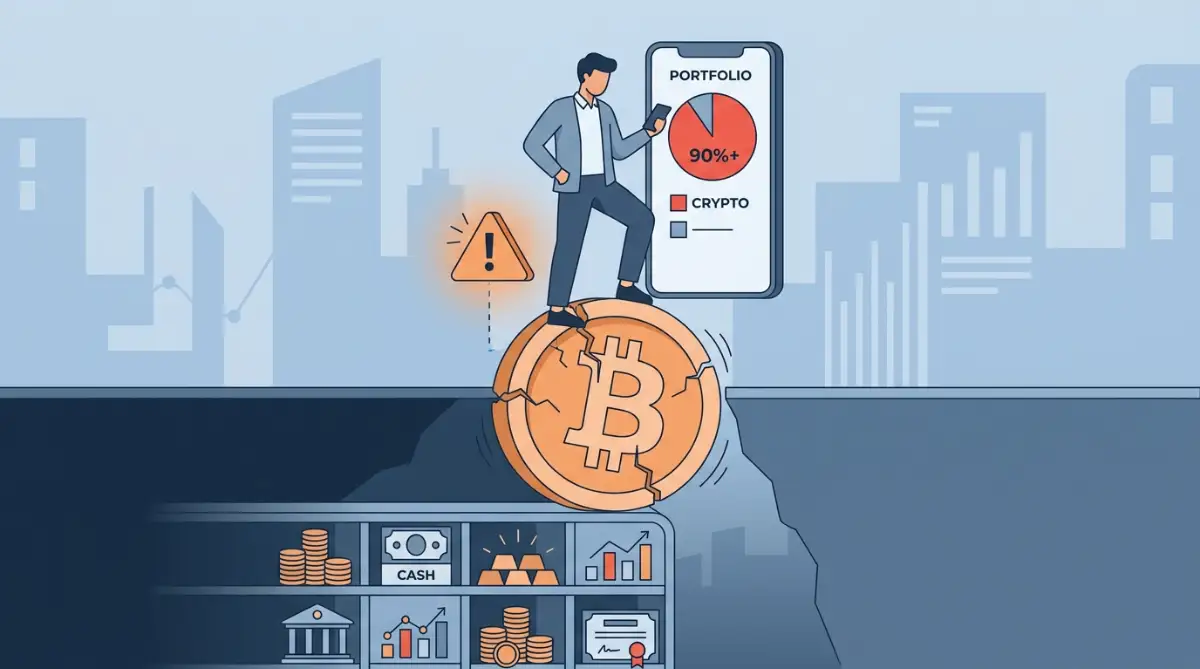
Owning twenty highly similar cryptocurrencies does not necessarily create a diversified portfolio.
Imagine someone owns:
- Coin A
- Coin B
- Coin C
- Coin D
- Coin E
If all five respond almost identically to Bitcoin's price movements, the investor may not actually be reducing much risk.
Instead, they have spread their money across multiple assets that behave in similar ways.
True diversification considers how investments relate to one another—not just how many assets exist.
Why Most Cryptocurrencies Often Move Together
One unique feature of the cryptocurrency market is its strong correlation.
When Bitcoin rises sharply, many alternative cryptocurrencies often rise as well.
When Bitcoin experiences major declines, a large portion of the market frequently falls together.
This means diversification inside crypto alone has limitations.
Although some projects outperform or underperform others, major market movements often affect nearly everyone.
That is why diversification should never be viewed as a guarantee against losses.
The Difference Between More Coins and Better Diversification
These ideas sound similar but produce very different results.
More Coins
Buying many cryptocurrencies without understanding them.
Characteristics include:
- Random purchases
- Following social media trends
- Chasing recent price increases
- No investment strategy
- Duplicate exposure
Better Diversification
Carefully selecting investments based on different characteristics.
This may include considering:
- Different blockchain sectors
- Various use cases
- Market capitalization
- Risk levels
- Long-term development activity
Quality almost always matters more than quantity.
Can Diversification Protect Against Market Crashes?
Not completely.
During severe crypto bear markets, many assets decline together.
History has shown that even respected projects can lose significant value during prolonged downturns.
Diversification may reduce losses compared to holding a single failing project, but it cannot completely shield investors from widespread market declines.
This is an important distinction.
Diversification manages risk.
It does not eliminate risk.
The Hidden Problem of Over-Diversification
Another issue receives far less attention.
Owning too many cryptocurrencies creates new challenges.
These include:
Harder Portfolio Management
Monitoring dozens of projects requires considerable time.
Investors need to follow:
- Development updates
- Security news
- Governance changes
- Market conditions
- Regulatory developments
Keeping up becomes increasingly difficult.
Reduced Research Quality
Instead of deeply understanding a few investments, attention becomes scattered across many.
This may lead to weaker decision-making.
Smaller Potential Impact
If an investor owns many tiny positions, exceptional performance from one asset may have little effect on the overall portfolio.
Finding a balance becomes important.
Building a Diversified Portfolio With Purpose Instead of Fear
One of the healthiest mindset shifts an investor can make is moving away from the idea that diversification is about avoiding every possible loss. Instead, think of it as creating a portfolio that can better withstand uncertainty without relying on a single outcome.
Every cryptocurrency investment carries some level of risk. Diversification is not about finding a perfect combination that never loses value. Rather, it is about reducing the chance that one poor decision or one unexpected event severely damages your entire portfolio.
A thoughtful portfolio is built with intention, not anxiety. Before adding any new asset, ask yourself:
- Does this investment serve a different purpose than what I already own?
- Am I adding this because of research or because of recent social media hype?
- If this asset declined significantly tomorrow, would I still understand why I invested in it?
- Does this project fit my overall investment goals?
These questions encourage discipline and help prevent unnecessary portfolio expansion.
Looking Beyond the Number of Coins You Own
Many beginners feel more secure when they own a large collection of cryptocurrencies. Seeing ten or fifteen different assets in a wallet may create the impression of lower risk.
However, appearance and reality are often different.
Imagine two investors.
The first investor owns fifteen cryptocurrencies that all belong to similar blockchain sectors and tend to react similarly during market swings.
The second investor owns only four carefully researched projects with different use cases, varying market capitalizations, active development communities, and clear long-term objectives.
Although the second portfolio contains fewer assets, it may actually represent better diversification because every holding contributes something unique.
The lesson is simple:
A diversified portfolio is measured by the quality of its structure, not by the number of tokens it contains.
Understanding Correlation Before Adding New Investments
Correlation describes how different assets move in relation to each other.
If two cryptocurrencies usually rise and fall together, owning both may not significantly reduce portfolio risk.
For example, during periods of broad market optimism, many cryptocurrencies experience gains at the same time. During sharp market declines, those same assets often fall together.
This does not mean diversification is ineffective.
Instead, it reminds investors that diversification has limits inside a highly connected market.
Before adding another cryptocurrency, consider questions such as:
- Does this project operate in a different ecosystem?
- Is its long-term purpose different from assets I already own?
- Does it depend on similar market conditions for growth?
- Am I simply buying another asset because everyone else is discussing it?
These questions encourage thoughtful investing rather than impulsive accumulation.

The Role of Research in Effective Diversification
Diversification should never replace research.
This mindset can become dangerous.
Every investment deserves careful evaluation.
Areas worth researching include:
Development Activity
Projects with active development often demonstrate ongoing commitment to improvement.
Regular updates, transparent communication, and meaningful technical progress can indicate a healthier ecosystem than projects that rarely evolve.
Community Strength
Large communities alone do not guarantee quality.
Instead, observe whether discussions focus on education, development, problem-solving, and long-term progress rather than constant price speculation.
Security History
Understanding previous security incidents can provide valuable context.
Research whether vulnerabilities were addressed responsibly and whether the project continues improving its security practices.
Utility
Ask what real problem the cryptocurrency attempts to solve.
Projects with practical applications may have stronger long-term foundations than those driven primarily by speculation.
Diversification Cannot Replace Risk Management
One of the biggest misconceptions in investing is believing diversification alone creates safety.
In reality, diversification is only one component of responsible risk management.
Strong investors also consider:
- Position sizing
- Investment time horizon
- Personal financial goals
- Liquidity needs
- Emergency savings
- Emotional discipline
These elements work together.
Ignoring them while relying entirely on diversification may leave an investor vulnerable during unexpected market events.
Why Emotional Control Still Matters
Even the most diversified portfolio cannot protect someone from emotional decision-making.
Consider common reactions during volatile markets.
Panic Selling
Sharp price declines often create fear.
Selling every investment during moments of uncertainty may lock in losses that could have been temporary.
Fear of Missing Out
Rapid price increases can encourage investors to abandon carefully planned strategies.
Buying assets solely because others appear to be making profits often increases unnecessary risk.
Constant Portfolio Changes
Frequently replacing investments based on daily news or online discussions may reduce consistency and increase emotional stress.
Diversification works best when paired with patience and disciplined decision-making.
How Long-Term Thinking Changes the Value of Diversification
Short-term traders and long-term investors often view diversification differently.
Someone making frequent trades may focus heavily on daily market movement.
Long-term investors, however, often pay greater attention to broader trends such as:
- Technology development
- Network adoption
- Regulatory evolution
- Security improvements
- Market maturity
A longer investment horizon allows diversification to work more effectively because temporary volatility becomes less influential than long-term progress.
Patience does not eliminate risk, but it often reduces the impact of short-term emotional decisions.
Practical Habits That Support a Healthier Portfolio
Good investing habits often matter more than constantly searching for the next popular cryptocurrency.
Consider incorporating routines such as:
Review Instead of React
Schedule periodic portfolio reviews rather than responding to every market headline.
Regular evaluations encourage rational thinking.
Keep Learning
The cryptocurrency industry changes rapidly.
Learning about blockchain technology, cybersecurity, decentralized finance, market structure, and digital asset storage can improve future investment decisions.
Maintain Clear Records
Keeping track of purchases, investment reasons, research notes, and portfolio changes makes future reviews much easier.
It also helps identify recurring mistakes that might otherwise go unnoticed.
Focus on Personal Goals
Every investor has different objectives.
Some prioritize long-term growth.
Others value capital preservation.
Some simply wish to understand emerging technology.
Comparing your strategy to someone else's may create unnecessary pressure.
Mistakes That Often Reduce the Benefits of Diversification
Even investors who understand diversification sometimes weaken its effectiveness through avoidable mistakes.
Buying Without Understanding
Purchasing unfamiliar cryptocurrencies simply because they appear popular increases uncertainty rather than reducing it.
Knowledge should always come before investment.
Ignoring Portfolio Balance
Allowing one investment to grow into an overwhelming percentage of the portfolio may gradually reduce diversification over time.
Occasional reviews help maintain balance.
Following Online Hype
Social media discussions can introduce useful ideas, but popularity should never replace independent research.
Markets often react emotionally, especially during periods of excitement.
Assuming Every New Coin Adds Protection
Adding more assets does not automatically improve portfolio quality.
If new investments share similar risks with existing holdings, the additional complexity may provide little meaningful protection.
Forgetting Personal Risk Tolerance
Every investor has a different comfort level with volatility.
A portfolio should reflect individual financial circumstances rather than internet trends.
A Balanced Perspective on Diversification
Diversification deserves its reputation as an important investment principle, but it should not be treated as a guarantee.
It reduces certain risks while leaving others unchanged.
It helps limit exposure to individual project failures but cannot prevent broad market downturns.
It encourages balance but cannot replace research.
It supports long-term investing but cannot eliminate emotional mistakes.
Understanding these realities helps investors develop healthier expectations.
Rather than searching for a strategy that promises complete safety, experienced investors often focus on creating portfolios that remain resilient across changing market conditions.
That balanced perspective is ultimately more valuable than believing any single investment technique can solve every challenge.

Frequently Asked Questions
Is owning more cryptocurrencies always safer?
No. Safety depends on the quality, diversity, and purpose of the investments rather than the total number of assets. Several highly correlated cryptocurrencies may still expose a portfolio to similar risks.
Can diversification prevent losses during a crypto market crash?
No. Diversification may reduce the impact of individual project failures, but widespread market declines can affect many cryptocurrencies at the same time.
Should beginners diversify immediately?
Learning the fundamentals of blockchain, cryptocurrency risks, and portfolio management before expanding into multiple assets is often more beneficial than purchasing many coins without research.
How often should a diversified portfolio be reviewed?
There is no universal schedule. Periodic reviews based on personal investment goals and significant market developments are generally more effective than reacting to daily price movements.
Is diversification only useful in cryptocurrency investing?
No. Diversification is a widely recognized investment principle used across many financial markets. However, its effectiveness depends on how different assets behave relative to one another.
Key Takeaways
Diversification remains one of the most valuable concepts in investing, but it is frequently misunderstood in the cryptocurrency market. Simply owning more coins does not automatically create a safer portfolio. Real diversification comes from understanding risk, researching each investment, maintaining balance, managing emotions, and aligning every decision with clear financial objectives.
Investors who combine diversification with continuous learning, disciplined risk management, and realistic expectations are generally better prepared to navigate the uncertainty that naturally exists in digital asset markets.
Disclaimer: This article is intended for educational and informational purposes only. It should not be considered financial, investment, legal, or tax advice. Cryptocurrency markets are highly volatile, and all investments involve risk. Always conduct your own research and consider consulting a qualified financial professional before making investment decisions.