Why Patience Beats Timing in Long-Term Crypto Investing
Crypto investing often gets framed like a game of perfect timing. Buy before prices pump, sell before they dump, and somehow guess the next big move. On social media, it can look easy—but real markets don’t really work on a schedule.
For long-term investors, one of the most important skills isn’t predicting what happens next. It’s staying patient when things get exciting, scary, or just plain confusing.
That’s where crypto investing psychology really comes into play.
The crypto market is full of sharp price swings, sudden hype, fear-driven sell-offs, and nonstop information. All of that can push people into emotional decisions instead of sticking to a plan. Someone might buy because prices are pumping, sell because they’re dropping fast, or keep jumping in and out trying to catch every move.
Patience offers a different approach.
Instead of trying to predict every twist and turn, a patient investor focuses on time horizon, risk, research, and consistency. It’s not about ignoring risk or just holding forever no matter what. It’s about understanding that long-term investing is a completely different mindset from short-term trading.
Educational note: Cryptocurrency is highly volatile and can result in substantial losses, including the loss of invested capital. This article is for educational purposes only and is not personalized financial, investment, tax, or legal advice. Always conduct independent research and consider your financial circumstances and risk tolerance before making investment decisions.
Why Market Timing Looks Easier Than It Really Is
Market timing sounds simple in theory.
If you could always buy at the bottom and sell at the top, the returns would look amazing. The problem is those “perfect” moments are usually only obvious after they’ve already passed.
During a crash, it’s hard to know if prices are just dipping or heading into a long downturn. During a rally, it’s just as hard to know if it’ll keep going or suddenly reverse.
That’s where investors get caught in a mental trap.
People wait for the “perfect” entry, but prices move before they feel ready. Others wait for confirmation, buy late, and then panic when things pull back.
Selling has the same issue.
You might plan to exit at a certain price, but optimism keeps you holding. Or fear kicks in and you sell way earlier than you intended.
Either way, emotions start running the show.
The Hidden Difficulty of Predicting Crypto Markets
Crypto prices move based on a mix of things—sentiment, liquidity, tech updates, regulations, macro trends, adoption, and expectations.
Even when everyone sees the same news, they don’t interpret it the same way.
That’s what makes timing so hard.
Long-term investing shifts the question from:
“Can I predict the next move?”
to:
“Can I stay consistent and make solid decisions even when things are uncertain?”
That small shift changes everything.
Patience Is a Skill, Not Just Waiting Around
A lot of people think patience just means doing nothing. But in investing, it’s more active than that.
A patient crypto investor usually does a lot of upfront work—researching the project, understanding what it does, checking risks, and thinking about how it fits into their overall plan.
After that, patience means not reacting to every price swing like it’s a big event.
There’s a big difference between patient investing and just holding blindly.
Patient investing still involves checking in and reassessing when something actually changes. Blind holding assumes everything will recover just because it went down—which isn’t always true.
Time Helps You Stop Overreacting
Short-term traders often need to make constant decisions because their strategy depends on price movement.
Long-term investors don’t need to do that as much.
Fewer decisions usually means fewer emotional mistakes.
If you’re checking prices all day, every small move starts to feel important. That can easily lead to panic buying or panic selling.
A longer time horizon helps you zoom out and see the bigger picture.
It doesn’t remove risk, but it helps you avoid reacting to every little move.
The Psychology Behind Emotional Crypto Decisions
People aren’t perfectly rational—especially in fast-moving markets like crypto.
Fear of Missing Out (FOMO)
FOMO happens when you feel like everyone else is making money and you’re missing out.
That pressure can push people to buy without thinking it through.
A more grounded approach is to pause and ask:
- Do I actually understand this project?
- Why am I buying it?
- What risks am I taking?
- Does this fit my plan?
- Would I still be okay if the price drops right after I buy?
These questions help slow down emotional decisions.
Panic Selling
The opposite is panic.
When prices drop fast, it can feel uncomfortable to just watch it happen. Selling gives quick relief because it stops the stress.
But selling in fear doesn’t always match your original plan.
Of course, if something fundamentally changes with a project, reassessing makes sense. The key is separating real risk from emotional reaction.
Recency Bias
Recency bias is when recent events feel more important than they really are.
If prices have been going up, people assume they’ll keep going up. If they’ve been falling, people assume they’ll keep falling.
But markets don’t move in straight lines.
That’s why decisions should be based on broader research, not just what’s happening right now.
Why Patience Can Be More Practical Than Perfect Timing
Let’s compare two types of investors.
Investor A tries to time everything. They jump in and out, react to news, and constantly try to predict the next move.
Investor B takes a long-term approach. They do research, set risk limits, and avoid reacting to every short-term move.
Investor B will still make mistakes—but they’re not relying on perfect timing to succeed.
That’s the key difference.
Patience doesn’t guarantee better results. It just reduces the need to be perfect.
And in crypto, that matters a lot.

Building a More Disciplined Long-Term Crypto Mindset
Patience becomes easier when you set rules before emotions kick in.
Define Your Time Horizon
Decide how long you actually plan to hold an investment.
If you’re thinking in years, daily price moves matter a lot less.
Know Why You Own It
Ask yourself:
“What would make me change my mind about this investment?”
If you can’t answer that, your decision might be based more on hope than logic.
Filter Out Market Noise
Not everything you see online deserves your attention.
Try separating:
- Real project updates
- Short-term hype
- Social media opinions
- Rumors
- Marketing noise
This helps you stay focused.
Set Risk Limits
Patience is hard when you’ve taken on more risk than you can handle.
Crypto is volatile, so it’s important to only invest what you can afford to lose and avoid putting yourself in a position where emotions take over.
A Simple Framework for Handling Volatility
When prices move sharply, don’t rush.
Step 1: Ask What Actually Changed
Did the project change—or just the price?
Step 2: Check Real Sources
Look at reliable information, not just social media noise.
Step 3: Revisit Your Original Reason
Do your original reasons still make sense?
Step 4: Reassess Risk
Even if the idea is still valid, the risk level might have changed.
Step 5: Take a Breather
If you don’t need to act immediately, give yourself time to think.
Patience Doesn’t Mean Ignoring Problems
Long-term investing doesn’t mean holding forever.
You still need to review your investments regularly.
If something fundamentally breaks—like security issues, development problems, or major changes in the project—then it’s okay to rethink your position.
Patience is not about ignoring reality. It’s about not overreacting to noise.
Conviction vs Overconfidence
Conviction is based on research and reasoning.
Overconfidence is assuming you’re definitely right.
A healthy mindset sounds like:
“I believe in this, but I could be wrong.”
That leaves room for new information.
Why Consistency Beats Excitement
Long-term investing isn’t always exciting.
Sometimes nothing happens for a while. Prices move sideways. Narratives change. It can feel boring.
That’s when people start chasing hype.
But consistency usually works better than constant action.
The goal isn’t to win every move—it’s to stick to a process.
Common Mistakes That Hurt Patience
- Checking prices too often
- Chasing hype
- Buying more without research after losses
- Trusting random predictions
- Thinking long-term means never reviewing
A Healthier Definition of Long-Term Crypto Investing
Long-term crypto investing isn’t about catching perfect tops or bottoms.
It’s about building a research-based approach, accepting uncertainty, managing risk, and staying disciplined while still being willing to adjust when needed.
Crypto will always be noisy.
Patience helps you step back from that noise.
Instead of asking, “How do I time this perfectly?” a better question is:
“How do I stay consistent even when I can’t predict what happens next?”
That mindset is one of the most useful parts of crypto investing psychology.
Key Takeaways
- Timing the market is extremely difficult in crypto
- Patience helps reduce emotional decision-making
- FOMO, panic selling, and bias can strongly influence behavior
- Long-term investing requires research and risk awareness
- Patience is not the same as blindly holding
- Regular review of investments is still important
- Risk management is essential in volatile markets
- A clear process helps reduce emotional reactions
- No strategy guarantees profits
At the end of the day, patience doesn’t mean you know everything. It just means you’re not letting the market control your decisions.
Turning Patience Into an Everyday Investing Habit
Patience gets a lot easier when it’s supported by a simple, repeatable routine.
Without one, most people just react to whatever emotion is strongest in the moment. When prices go up, optimism takes over. When prices drop, fear kicks in. When social media gets hyped, curiosity can quickly override caution.
A routine helps create a buffer between the market and your decisions.
Create a Personal Investment Checklist
Before making any big move, it helps to have a short checklist you can actually use.
For example:
- What’s the purpose of this investment?
- What information supports this decision?
- What are the main risks?
- How does this fit into my overall portfolio?
- What could prove my original idea wrong?
- Am I acting based on evidence or emotion?
The point of a checklist isn’t to predict the market.
It’s just to keep you consistent.
When you ask yourself the same questions over and over, you rely less on mood or whatever narrative is trending that day.
Separate Decisions From Feelings
Emotions aren’t the enemy.
Fear can sometimes highlight real risk. Excitement can push you to explore new opportunities. Even concern can help you double-check whether your exposure is getting too large.
The problem starts when emotion becomes the only reason for a decision.
Instead of saying, “I feel like prices will go up,” try asking, “What actually supports that idea?”
Instead of saying, “I’m scared because prices are dropping,” ask, “What has actually changed?”
That small shift—from emotion to question—can make a big difference in decision quality.
The Importance of Decision Windows
Not every decision needs to happen right away.
Fast markets can make it feel like if you don’t act immediately, you’ll miss out forever. That pressure often leads to rushed choices.
A decision window simply gives you time to think before acting.
For non-urgent decisions, it can be as simple as stepping away, reviewing your notes, and coming back later with a clearer head.
This doesn’t mean delaying everything endlessly.
It just means recognizing that urgency and importance aren’t always the same thing.
Crypto can move fast without forcing you to abandon your process.
Why Slowing Down Can Improve Clarity
When emotions are high, people tend to focus on only part of the picture.
If someone is excited, they’ll mostly see bullish signals. If someone is scared, they’ll mostly see negative headlines.
Taking a pause helps widen your view.
Instead of only asking, “How much can I make?” you can also ask:
- What could go wrong?
- What assumptions am I making?
- What evidence would change my mind?
- Am I ignoring downside risk?
That leads to more balanced thinking.
Building a Portfolio That You Can Actually Live With
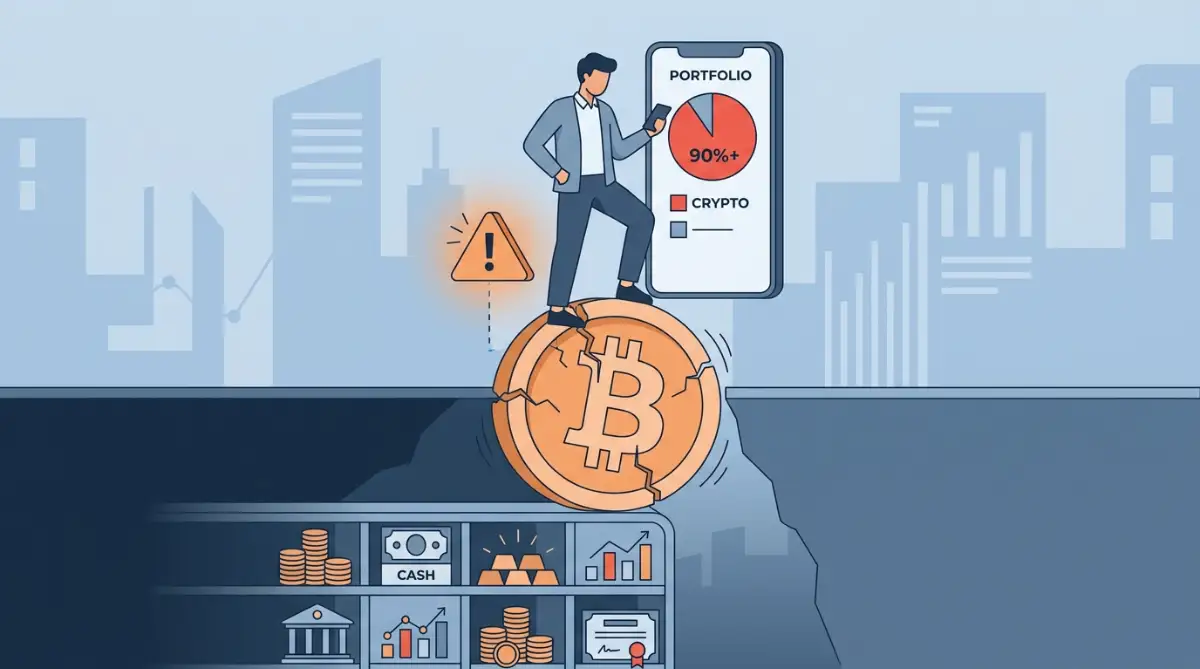
A strategy might look great on paper, but if you can’t emotionally handle it, it won’t last.
For example, someone might build a portfolio with heavy crypto exposure because they believe strongly in the long-term future of digital assets. But if the market drops sharply, that same person might struggle to sleep, focus, or stick to their plan.
That kind of pressure often leads to emotional decisions.
This is why portfolio design and psychology are closely connected.
Risk Tolerance Is More Than a Number
Risk tolerance isn’t just a percentage on a spreadsheet.
It’s also behavior.
Two people can have the same financial capacity for risk but react very differently to volatility.
One might stay calm during a big drawdown. Another might panic after a much smaller drop.
Understanding how you react to volatility is just as important as understanding the math.
A sustainable portfolio is one you can actually stick with when things get uncomfortable.
The Role of Position Size in Emotional Control
Position size has a bigger impact on psychology than most people realize.
If one asset takes up a large portion of your portfolio, every price move feels important.
Even if volatility is the same in percentage terms, the emotional impact is much higher.
This doesn’t mean there’s a universal “right” allocation.
The key idea is simple:
Your position size should match the level of risk you can realistically handle.
When a position is too large, patience becomes much harder to maintain.
How Information Overload Changes Investor Behavior
Crypto investors are surrounded by information.
Market updates, project news, technical analysis, macro commentary, podcasts, videos, social media threads—it never really stops.
But more information doesn’t automatically mean better decisions.
Sometimes it just creates noise.
The Problem With Constant Financial Content
Imagine checking the market in the morning and seeing a bullish prediction.
A few hours later, you read a warning about a crash.
Later, someone else says a new development changes everything.
After enough conflicting opinions, you might feel like you have to do something just to reduce uncertainty.
That’s decision fatigue.
At that point, you’re not acting because the evidence changed—you’re acting because you’re mentally overloaded.
Choose Information Sources Carefully
A more stable approach is to limit your sources to a small, reliable set.
For example:
- Official project documentation
- Verified announcements
- Reputable financial reporting
- Primary technical resources
- Transparent independent research
- Regulatory updates when relevant
This doesn’t mean these sources are always right.
It just reduces the chance of making decisions based on random noise or emotional commentary.
Why Social Media Can Distort Crypto Expectations
Social media is built to grab attention.
Extreme opinions tend to spread faster than balanced analysis.
A bold prediction will usually get more engagement than a careful explanation of uncertainty.
Over time, this can distort expectations.
Compare Reality With Online Narratives
A helpful habit is to check whether the story matches actual evidence.
If people are talking about massive growth, what real adoption supports that?
If there’s talk of a crash, what data backs it up?
If someone gives a huge price target, what assumptions are they using?
These questions help turn passive scrolling into active thinking.
The goal isn’t to distrust everything.
It’s just to avoid confusing popularity with truth.
The Value of Keeping an Investment Journal
An investment journal can be surprisingly powerful for building patience.
Before making a decision, you can write down:
- Why you’re making the investment
- Your time horizon
- Key risks
- Main assumptions
- What would change your mind
- How you’re feeling at the time
Later, you can look back and see what actually happened.
This helps you study your behavior, not just the market.
Learning From Your Own Decisions
For example, you might notice that most impulsive buys happen after big price spikes.
Or you might realize you tend to sell after reading scary headlines without checking facts.
These patterns are incredibly useful.
The journal becomes a record of how you think—not just what you bought or sold.
Understanding Opportunity Cost
Patience doesn’t mean holding everything forever.
Capital is limited.
If an investment keeps taking attention and money while the original idea weakens, there’s an opportunity cost to staying in it.
That’s why regular reassessment matters.
Instead of asking:
“Will this eventually recover?”
A better question is:
“If I didn’t already own this, would I buy it today?”
That removes emotional attachment to your entry price.
Avoiding the Sunk Cost Trap
The sunk cost effect happens when people stick with a decision mainly because they’ve already invested time or money into it.
In crypto, this often shows up as emotional attachment to a coin.
Someone might think:
“I’ve held this for so long, I can’t sell now.”
But past time spent doesn’t determine the best decision today.
Evaluate the Present Situation
A better approach is to focus on current reality.
Ask:
- Has the thesis improved or weakened?
- Has risk changed?
- Are there new developments?
- Does the original reason still apply?
This helps you learn from the past without being stuck in it.
Patience and Dollar-Cost Averaging: Understanding the Difference
Dollar-cost averaging is often mentioned alongside long-term investing.
It simply means investing fixed amounts at regular intervals instead of trying to time a perfect entry.
This can reduce pressure and help avoid overthinking every market move.
But it’s not a guarantee of profit, and it’s not right for every situation.
The key benefit is psychological—it can reduce the urge to constantly predict short-term moves.
Still, any recurring investment plan should consider risk, valuation, personal finances, and the possibility of losses.
Why Long-Term Thinking Requires Realistic Expectations
Patience becomes risky when it’s based on unrealistic expectations.
If someone assumes every crypto will eventually deliver huge returns, they may ignore warning signs.
Long-term thinking should include uncertainty.
A realistic investor understands that:
- Some projects will fail
- Some assets will lose value permanently
- Market conditions change
- Technology evolves
- Competition increases
- Regulations matter
- Past performance doesn’t guarantee anything
This isn’t pessimism—it’s just reality.
Measuring Progress Without Obsessing Over Price
Price is important, but it’s not the only thing that matters.
Long-term investors should also look at their process.
Ask yourself:
- Am I sticking to my risk limits?
- Am I doing research before acting?
- Am I avoiding impulsive decisions?
- Am I using reliable information?
- Am I learning from mistakes?
- Am I keeping expectations realistic?
A good process doesn’t guarantee profits.
But it helps you tell the difference between a smart decision that didn’t work out and a careless one that got lucky.
That difference matters.
What to Do When Patience Is Tested
Every long-term investor eventually hits a rough patch.
Prices drop. Narratives break. Other assets outperform. Confidence gets shaken.
In those moments, it’s easy to react emotionally.
Instead of rushing, go back to your framework.
Recheck the Facts
Separate real developments from opinions.
Revisit Your Assumptions
Ask whether your original reasoning still holds.
Review Your Exposure
Check if your position still fits your risk tolerance.
Compare Alternatives Carefully
Don’t assume something is better just because it recently went up.
Make a Deliberate Decision
Act only if there’s a real reason to. Otherwise, don’t force action.
The Quiet Advantage of Doing Less, But Thinking Better
One underrated benefit of patience is that it reduces unnecessary activity.
Every trade adds complexity.
Every decision opens the door to emotional bias.
Every reaction can pull you away from your plan.
Doing less doesn’t automatically mean doing better—but avoiding unnecessary moves often helps.
Especially if you tend to check prices constantly.
The goal isn’t to ignore the market.
It’s to stop letting it control every decision.
A Practical Mental Model for Long-Term Crypto Investors
A simple way to think about decisions is in three layers:
Layer one: Evidence
What do I actually know?
Layer two: Risk
What could go wrong, and can I handle it?
Layer three: Time
Does this fit my investment horizon?
Only after that should emotion come in.
Emotion still matters—but it should be recognized, not blindly followed.
When Patience Becomes Your Competitive Edge
Markets constantly push you to react.
Up moves create urgency. Down moves create fear. Viral posts create excitement. Negative news creates doubt.
Patience creates space between stimulus and response.
That space is powerful.
It gives you time to think, verify, and decide whether action is even needed.
It doesn’t make you smarter than everyone else.
It just helps you avoid reacting too quickly.
A More Sustainable Way to Think About Crypto Investing
The best long-term approach isn’t about certainty.
It’s about preparation.
Research helps you understand what you own. Risk management helps you survive volatility. A clear process reduces impulsive behavior. Regular review keeps you updated. Patience gives everything room to work.
Even then, crypto will still be unpredictable.
There will still be rallies, crashes, hype cycles, and conflicting opinions.
But you don’t need to control any of that.
You just need to control your own process—how you manage risk, how you respond, and how you make decisions.

The Mindset That Makes Long-Term Investing Sustainable
Patience doesn’t guarantee success.
It just helps you avoid turning short-term emotions into long-term mistakes.
In crypto, that alone is a big advantage.
A patient investor can still change their mind, admit mistakes, reduce exposure, or exit positions when needed.
The difference is why those decisions happen.
Not because of panic or hype—but because the evidence supports it.
That’s what makes patience a real investing discipline, not just a personality trait.
A Short Reflection for the Long-Term Investor
Before the next big market move, it’s worth remembering:
You can’t control timing, but you can control how prepared you are.
A strong process won’t predict every move.
But it will help you make decisions you understand and can stand behind.
That’s the real value of patience in long-term crypto investing.
It doesn’t remove uncertainty—but it helps you stop reacting to it blindly.
And when combined with research, risk management, and realistic expectations, it makes the whole journey a lot more stable and manageable.
Important Disclaimer
This article is provided for general educational and informational purposes only. It does not constitute financial, investment, tax, accounting, or legal advice, and it does not recommend buying, selling, or holding any particular cryptocurrency or digital asset.
Cryptocurrency investments are highly speculative and can experience substantial price volatility. You may lose some or all of the money you invest. Past performance, historical patterns, market narratives, or general investing principles do not guarantee future results.
Before making an investment decision, conduct your own research and consider your financial objectives, investment horizon, liquidity needs, and tolerance for loss. Where appropriate, consider seeking advice from a qualified financial professional who understands your individual circumstances.
Nothing in this article should be interpreted as a guarantee of returns, a prediction of future cryptocurrency prices, or an endorsement of any specific digital asset, platform, project, exchange, or investment strategy.