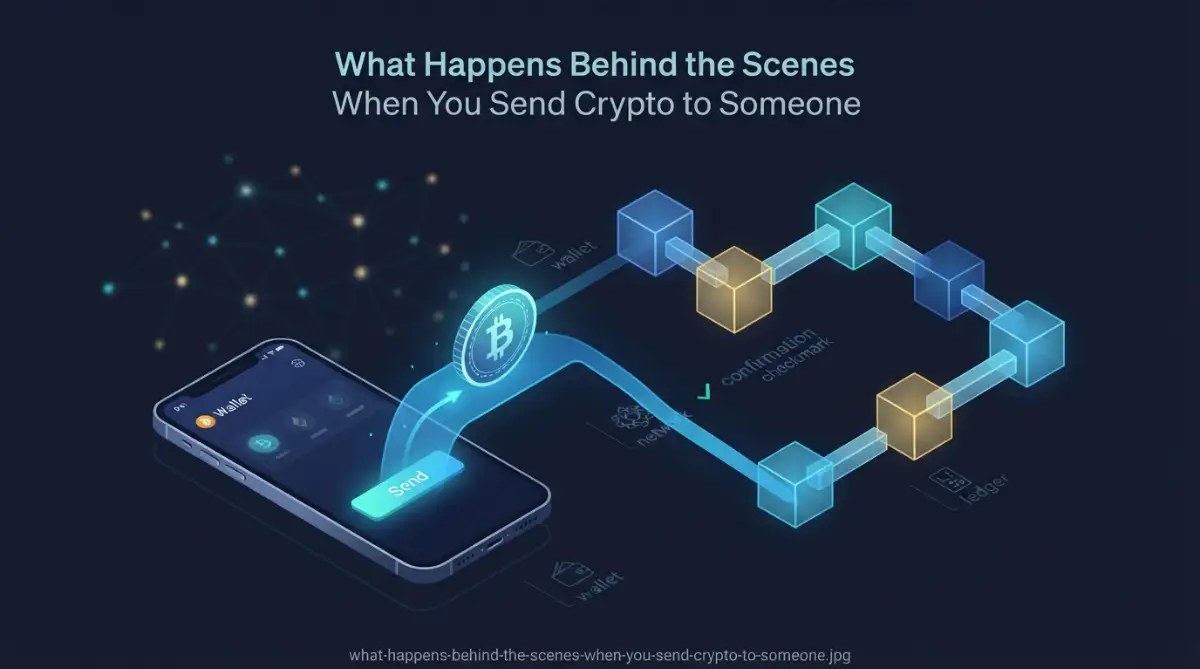
Why “Coin” and “Token” Often Sound Like the Same Thing
Imagine opening a cryptocurrency app and seeing Bitcoin, Ether, USDT , and hundreds of other digital assets listed together.
They may all look similar on the screen, but they do not all work in the same way.
For a beginner, this creates a frustrating problem. You may hear someone say, “This is a coin,” while another person calls a similar asset a “token,” and both terms can appear to be used interchangeably.
That confusion can affect how you understand a crypto project, what its asset is designed to do, and even how you assess its risks.
The problem becomes worse when short social-media posts reduce complicated blockchain concepts to one sentence.
Why Online Crypto Explanations Can Be Misleading
- Some explanations focus only on price, instead of explaining what the asset actually does.
- The word “coin” is often used for almost every cryptocurrency, even when the asset technically operates on another blockchain.
- Tokens can have very different purposes, from representing value to powering applications or giving access to certain features.
- Marketing language can make an asset sound more important than its technical role actually is.
- Beginners may assume that a higher price or larger market cap means an asset has a stronger technical foundation.
When basic terminology becomes unclear, it is harder to ask the right questions.
You may know an asset’s name and price but still have no idea whether it has its own blockchain, depends on another network, or serves a specific application.
Confusion Can Quietly Damage Your Confidence
Crypto already involves unfamiliar terms, changing prices, wallets, networks, fees, and security concerns.
When you cannot understand the basic difference between a coin and a token, every new piece of information can feel harder than it needs to be.
- You may feel pressured to understand everything before asking simple questions.
- You may hesitate to research an unfamiliar project because the technical language seems overwhelming.
- You may mistake popularity for utility because you do not know what role the asset plays.
- You may become overly dependent on social-media opinions instead of checking basic facts yourself.
That is not a lack of intelligence.
Blockchain terminology is genuinely confusing when it is explained without context.
The good news is that you do not need to become a blockchain developer to understand the distinction.
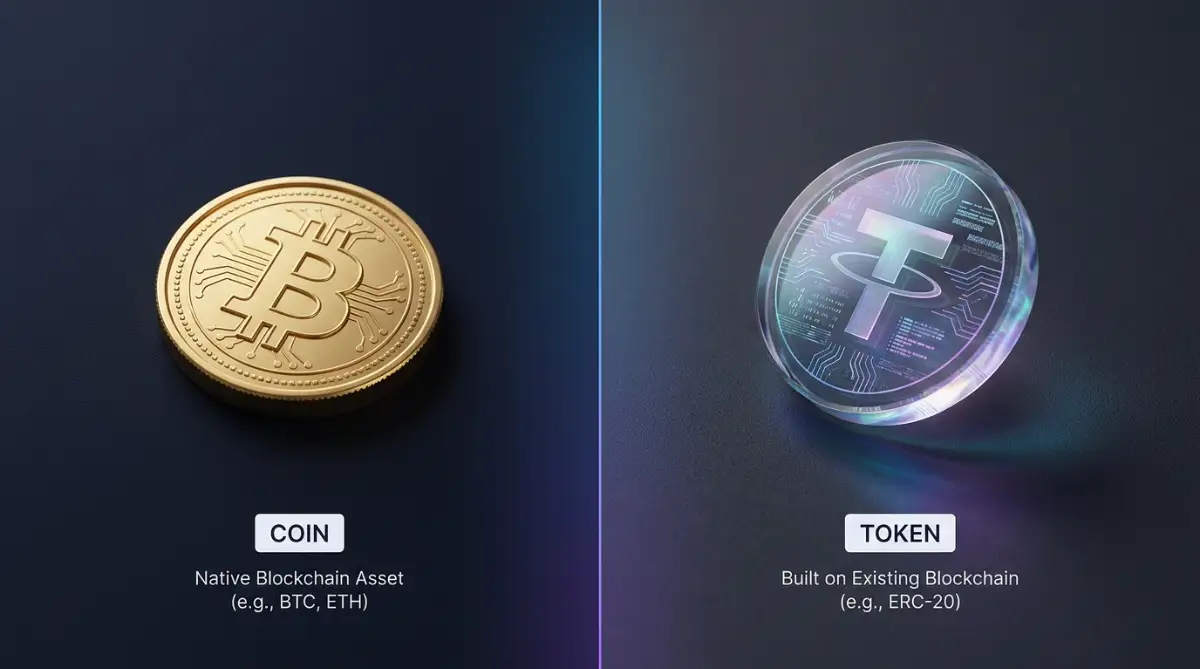
You only need to learn one simple idea first: a coin generally has its own native blockchain, while a token is created and operates on an existing blockchain.
That single distinction makes many other crypto concepts much easier to understand.
The Simple Analogy That Makes It Click
Think about a country and the currency used within its economy.
A blockchain can be compared loosely to the underlying economic system, while its native coin represents the digital asset built into that network.
A token is more like an asset created within an existing system.
This is not a perfect technical comparison, but it gives beginners a useful mental picture.
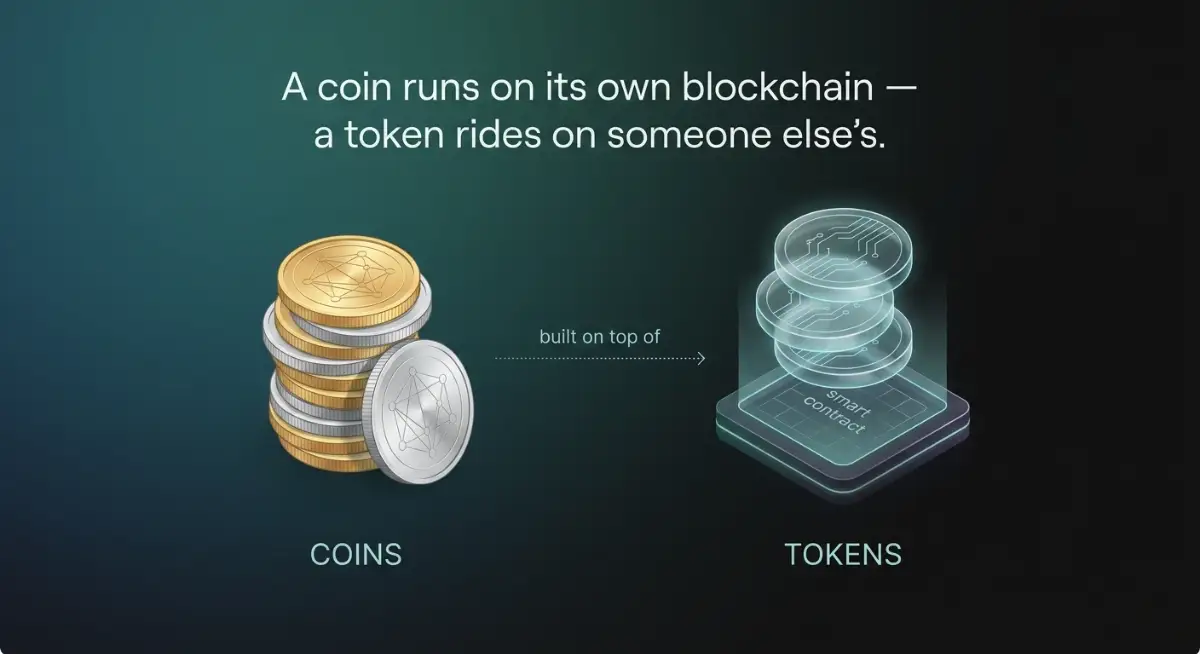
Coins belong to their own networks. Tokens are generally built on networks that already exist.
Once you understand that, names such as Bitcoin, Ether, stable coins, and application tokens become easier to separate.
Building a Clear Mental Model of Coins and Tokens
Before looking at practical examples, let’s establish the foundation.
The most useful question is not, “Which asset is better?”
Instead, ask:
“What blockchain does this asset actually operate on?”
That question can tell you far more than the label alone.
Start With the Blockchain Behind the Asset
What Makes a Coin a Coin?
A crypto coin generally refers to the native asset of its own blockchain.
Bitcoin is the native asset of the Bitcoin network.
Ether is the native asset of Ethereum.
Other blockchain networks can also have their own native coins.
The native asset can play several roles within its network.
It may be used to transfer value, pay network fees, or support activities that keep the blockchain functioning.
For example, transactions on a blockchain often require users to pay network fees.
Those fees are normally paid using the network’s native asset.
Bitcoin Developer Documentation
What Makes a Token Different?
A token is generally created on top of an existing blockchain.
Instead of creating an entirely separate blockchain, a project can use an established network and create digital assets through its available technical standards.
Ethereum is a well-known example because developers can create tokens that operate through smart contracts on the Ethereum network.
This means two different tokens can exist on the same blockchain while serving completely different purposes.
Ethereum Developer Documentation
A Quick Comparison
This table is a starting point, not a rule that explains every technical detail.
Crypto projects can use different designs, and terminology is sometimes used loosely in everyday conversation.
Step 1: Look for the Native Network
When you encounter an unfamiliar crypto asset, resist the urge to begin with its price.
Start by finding its native or underlying blockchain.
Suppose you discover an asset called “Example Token .”
Instead of immediately asking whether its price will rise, ask:
Which blockchain supports Example token?
If it operates through an existing blockchain, you are likely dealing with a token.
If it is the native asset of its own independent blockchain, it is generally classified as a coin.
A Practical Research Routine
You can apply this method whenever you encounter a new asset.
- Identify the asset name.
- Find the official documentation or technical information.
- Check which blockchain it uses.
- Determine whether it is native to that blockchain.
- Find out what the asset is designed to do.
This approach is much more useful than relying on a social-media post that simply calls something a “coin.”
Why the Network Matters
The blockchain behind an asset affects how transactions work.
It can influence network fees, transaction confirmation, security assumptions, available applications, and how the asset interacts with other digital assets.
For example, if you send a token through the wrong network, you can create a serious operational problem.
That is why understanding the underlying blockchain is not just a vocabulary exercise.
It can also help you avoid basic mistakes when handling digital assets.
Step 2: Separate the Asset From the Application
One of the biggest beginner mistakes is assuming that a token automatically represents an independent blockchain.
It usually does not.
A token may exist because a particular application or project needs a digital asset with a specific function.
Tokens Can Serve Different Roles
A token might be designed to represent:
- Access to a digital service
- A unit within an application
- A stable-value digital asset
- A voting or governance function
- A representation of another type of digital or real-world asset
- A reward within a particular ecosystem
These roles can be very different.
That means the word “token” tells you how the asset is structured, but it does not fully explain why the asset exists.
You still need to understand its purpose.
A Real-World Scenario
Imagine a company creates a digital platform for online communities.
Instead of building an entirely new blockchain, it uses an existing network and creates a token for certain functions inside the platform.
The token could potentially be used for access, rewards, or voting.
The platform does not suddenly become a separate blockchain simply because it has created its own token.
That distinction is easy to miss when crypto discussions focus heavily on names and prices.
Ask the Second Question
After identifying the blockchain, ask:
“What is this asset actually used for?”
This second question can reveal more than the label.
An asset with no clear purpose deserves careful research.
An asset with a clearly documented purpose still requires risk analysis, because usefulness alone does not guarantee success, adoption, security, or value.
Step 3: Understand Why Coins and Tokens Can Behave Differently
It is tempting to think that all digital assets behave similarly because they can be traded through crypto platforms.
But their technical foundations can be quite different.
A native coin is closely connected to the operation of its own blockchain.
A token depends on the blockchain where its smart contract or token system exists.
That creates different relationships between the asset and its network.
Think of It Like Renting Space vs Owning the Building
Here is a simple analogy.
A blockchain with its native coin is somewhat like a building with its own infrastructure.
A token created on that blockchain is more like a business operating inside that building.
The business may have its own identity and purpose, but it still depends on the building’s basic infrastructure.
Again, this is only an analogy.
The technical relationship is more complex, but the comparison helps explain why tokens depend on an underlying blockchain while native coins are tied directly to their own networks.
Network Fees Add Another Layer
Suppose you hold a token that operates on a particular blockchain.
You may still need that blockchain’s native coin to pay transaction fees.
This surprises many beginners.
They may think, “If I own the token, why can't I simply use the token to pay every transaction fee?”
The answer depends on the network’s design.
Different blockchains handle fees in different ways, but the general lesson is simple:
Owning a token does not necessarily mean you own the native asset required to interact with its network.
That is one reason basic blockchain knowledge can be useful before moving digital assets between wallets.
A Few Common Misunderstandings Worth Clearing Up
“Every Cryptocurrency Is a Coin”
Not exactly.
“Cryptocurrency” is a broad term that can describe many types of digital assets.
A coin is one category within that broader discussion.
A token is another common category.
So saying “all crypto assets are coins” removes an important technical distinction.
“Tokens Are Less Important Than Coins”
That conclusion does not follow from the terminology.
A token can play an important role within a widely used application or ecosystem.
Its importance depends on its function, adoption, design, security, and other factors—not simply whether it is called a coin or token.
“A Token Must Have Its Own Network”
Usually, no.
The defining idea is almost the opposite.
A token generally relies on an existing blockchain rather than maintaining its own independent blockchain.
If a project eventually develops and launches its own blockchain, its original asset structure may change or the project may migrate its asset to a different network.
“Coin vs Token Tells Me Which Investment Is Better”
No.
This distinction is mainly technical and structural.
It can help you understand an asset, but it does not tell you whether the asset is a good investment.
Investment decisions involve many other questions, including market demand, technology, competition, liquidity, security, regulation, project activity, and personal risk tolerance.
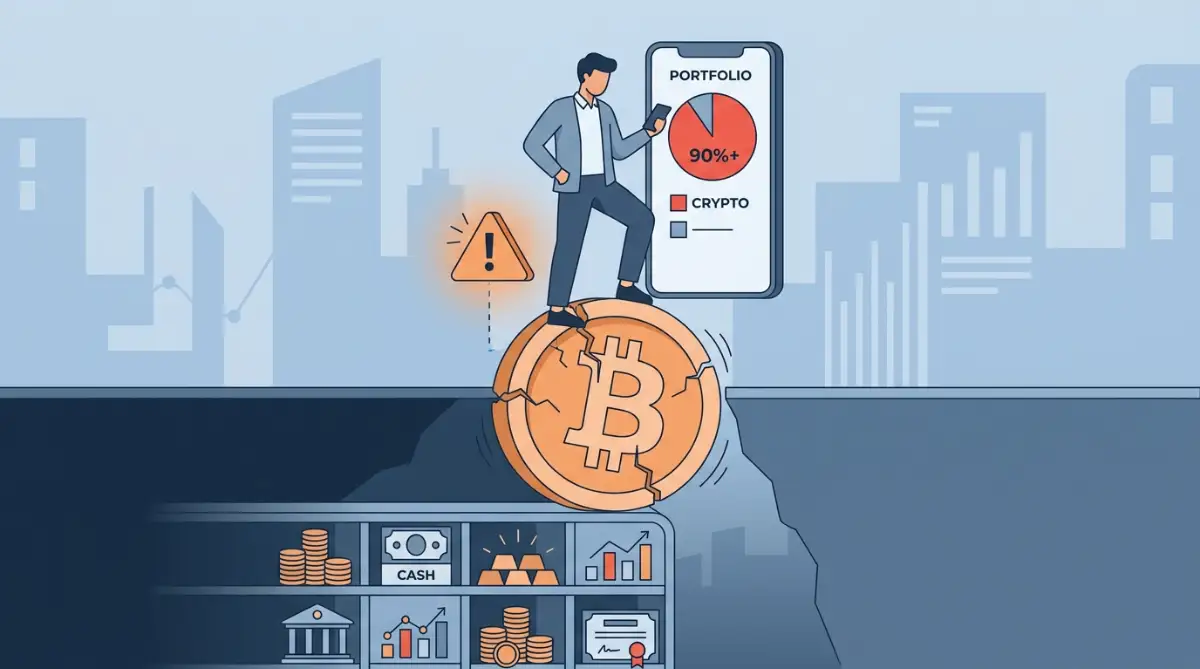
For a broader look at why simply owning more crypto assets does not automatically remove risk, see our guide to crypto diversification and portfolio risk.
What This Difference Means When You Research Crypto
Once you know how coins and tokens differ, you can stop treating every asset as if it were built the same way.
Instead, you can investigate the structure behind it.
Use This Five-Question Check
When you find a new digital asset, ask:
- What blockchain does it operate on?
- Is it native to that blockchain?
- What problem or function is it designed to address?
- How are transactions and fees handled?
- What risks could affect the network or project?
These questions take only a few minutes but can dramatically improve the quality of your research.
Why This Helps With Market Volatility
Crypto prices can move sharply for many reasons.
News, market sentiment, liquidity, regulation, technology changes, and broader economic conditions can all affect digital-asset markets.
Understanding the difference between a coin and a token does not predict those movements.
However, it helps you understand what you are actually looking at before you start interpreting its price.
If you want to understand why crypto prices can move so sharply, you can also explore our explanation of what causes major crypto market volatility.
One Simple Rule to Remember
If you remember only one thing from this part, make it this:
A coin is generally the native asset of its own blockchain. A token is generally created on an existing blockchain.
That is the basic dividing line.
But do not stop at the label.
When researching a digital asset, look beyond the name and price.
Find the blockchain.
Find the purpose.
Find out how the asset works.
Then consider the risks.
That habit gives you a much stronger foundation for understanding crypto than simply memorizing lists of popular coins and tokens.
When a Token Becomes More Than Just a Digital Balance
In Part 1, we established the basic distinction between a native coin and a token. Now we can look at what happens underneath the surface, because this is where the difference becomes much more useful in real situations.
A token is not simply a number displayed inside a wallet. In many blockchain systems, it is connected to a smart contract that defines how the asset behaves.
That small detail explains why tokens can be transferred, tracked, used inside applications, and sometimes given special rules without requiring the project to build an entirely separate blockchain.
Smart Contracts: The Engine Behind Many Tokens
A smart contract is essentially a program deployed on a blockchain.
On Ethereum, for example, smart contracts contain code and data at blockchain addresses, and users or applications can interact with their programmed functions.
Think of the Contract as a Rulebook
Imagine you have a digital points system for a large online community.
Instead of keeping a private spreadsheet showing who owns how many points, the rules could be implemented through blockchain software.
The program can define things such as who owns the units, how they can be transferred, and how the total supply is tracked.
That is one reason tokens can be useful for applications.
Why Token Standards Matter
Developers do not always have to invent every token function from scratch.
Ethereum's ERC-20 standard, for example, defines a common interface for fungible tokens, including functions for balances, transfers, approvals, and total supply.
This creates a shared language between the token and other blockchain applications.
A wallet can understand the expected functions.
A decentralized application can interact with the token using known methods.
Other software can potentially support the asset without creating a completely custom system.
Standardization is one reason a token can become usable across a wider ecosystem.
Ethereum's token standards documentation
The Difference Between “Having a Token” and “Having a Blockchain”
This is where many crypto discussions become confusing.
A project can have a token without having its own independent blockchain.
That means creating a token does not automatically mean the project has created a new network for processing transactions.
Picture Two Projects
Project A creates a blockchain and launches a native asset that helps users pay transaction fees on that network.
Project B builds an application on an existing blockchain and creates a token through a smart contract.
Both projects may have assets that people trade.
But their technical relationships with the blockchain are different.
Project A's asset is native to its own network. Project B's asset depends on an existing network.
That distinction matters when you investigate how each system works.
A Useful Research Trick: Follow the Contract
Suppose you discover a token on a crypto platform.
You see a familiar-looking name and ticker.
Instead of stopping there, look for the token's contract address and verify it through a trusted blockchain explorer or the project's official documentation.
Why?
Because names and symbols are not always enough to identify an asset.
Different contracts can use similar names or symbols.
A verified contract address gives you a much more precise technical reference.
What You Can Learn From a Contract
Depending on the network and available information, you may be able to inspect:
- Total token supply
- Token holders
- Transfer activity
- Contract interactions
- Creation or deployment details
- Whether the contract source has been verified
- Other technical information exposed by the network
This does not automatically prove that a project is safe.
It simply gives you better information than relying on a logo, ticker, or social-media post.
Why One Token Can Appear on More Than One Network
Here is another point that often surprises beginners.
The same project may have assets represented across different blockchain networks.
That does not necessarily mean there is one magical token simultaneously existing inside every network in exactly the same technical form.
Often, different representations or mechanisms are used to make an asset available across networks.
A Simple Example
Imagine you have a digital asset associated with one blockchain.
Users on another blockchain may still want to use an equivalent representation within that ecosystem.
A bridging system or another cross-network mechanism may be used to make that possible.
The exact design varies.
Some systems lock or hold assets in one environment while another representation is issued elsewhere.
Others use different technical approaches.
The important lesson is that “same name” does not always mean “same technical asset.”
Before transferring anything, always check the network carefully.
The Network Label Is Not Decoration
When a wallet asks you to choose a network, that choice has a real technical meaning.
Imagine you are trying to send a token to another wallet.
You select the asset correctly but choose an unsupported network.
The transaction may not arrive where you expected, and recovering funds can be difficult or sometimes impossible depending on the circumstances.
Ethereum's documentation also notes a specific risk with ERC-20 tokens: sending tokens to a smart contract that is not designed to receive them can result in permanent loss.
Your Personal Safety Check
Before making a blockchain transfer, pause for a moment.
Check:
Asset → Network → Destination → Address → Amount
Do not rush through this sequence just because the transfer looks simple.
A few seconds of checking can prevent a costly mistake.
An Expert Habit: Separate Technical Facts From Investment Claims
One of the smartest habits you can develop is learning to separate what an asset is from what someone claims it will become.
These are completely different questions.
Technical Question
“What is this asset?”
You can investigate its blockchain, contract, token standard, supply mechanism, and intended function.
Investment Question
“Will this asset increase in value?”
That question is much harder.
Its answer depends on uncertain factors such as demand, competition, adoption, liquidity, market conditions, regulation, technology, and investor behavior.
Knowing that an asset is a token does not tell you whether its price will rise.
Likewise, being a native coin does not automatically make an asset valuable.
The U.S. SEC's investor education materials warn that crypto-asset investments can involve significant risk and that investors should be cautious about claims surrounding these assets.
A Better Way to Read Crypto Project Information
When you visit a project's website, do not read only the promotional headline.
Look for technical and practical information.
Start With the Documentation
A serious research process should try to answer:
- What does the project actually do?
- Which blockchain supports the asset?
- Is the asset native or issued through a smart contract?
- What is the token used for?
- How is supply created or removed?
- Who controls important contract functions?
- Can the contract rules be changed?
- What happens if the application stops operating?
These questions help you move from marketing language to verifiable information.
Then Compare the Claims
Suppose a project says its token has a special function.
Do not simply accept the statement.
Look for technical documentation explaining how that function works.
If the project claims that its token has a fixed supply, investigate whether the contract actually prevents additional issuance or whether certain addresses have permission to create more units.
The point is not to become a programmer.
The point is to become a careful reader.
A Short Scenario: Two Assets With Similar Prices
Imagine you find two digital assets priced at $2 each.
At first glance, they appear equally affordable.
But price alone tells you very little.
Asset A might have a huge supply and operate as a token inside an existing ecosystem.
Asset B might be the native coin of a separate blockchain with a completely different supply structure.
Their identical prices do not mean they have identical value, utility, or market structure.
This is why unit price should never be your only comparison tool.
Market capitalization, circulating supply, fully diluted supply, usage, liquidity, network activity, and project fundamentals can all tell a different story.
Keeping Your Knowledge Useful Over Time
Learning the coin-versus-token distinction once is helpful.
Using that knowledge every time you research a new asset is much better.
Build a Small Personal Research Checklist
You do not need a complicated spreadsheet.
A simple note can contain:
Asset name:
Blockchain:
Native coin or token:
Contract address:
Main purpose:
Supply model:
Network fee asset:
Main risks:
Official documentation:
This turns random crypto browsing into a repeatable research process.
Why This Works
We often make mistakes when information arrives too quickly.
One social-media post says something is the next big project.
Another says it is worthless.
A third person claims they have discovered a secret opportunity.
Your checklist gives you a reason to slow down.
Instead of asking, “Who should I believe?” you can ask, “What can I verify?”
That is a much stronger position.

The Mistakes That Can Turn Simple Crypto Knowledge Into Expensive Problems
Understanding terminology is useful, but applying it carelessly can create new problems.
Here are the habits I would strongly avoid.
Treating the Word “Token” as a Quality Rating
A token is not automatically good or bad because it is a token.
The label describes its structure.
It does not certify the project's quality, security, popularity, or future prospects.
Technical category and investment quality are separate ideas.
Assuming a Famous Ticker Is Automatically the Correct Asset
A ticker symbol can be confusing because symbols and names may not uniquely identify a blockchain contract.
A fake or unrelated asset may use a similar name.
Always verify the asset through official documentation and the correct contract information before interacting with it.
Sending Assets Without Checking the Network
This is one of the most practical mistakes.
A user may copy an address, choose an asset, and press send without confirming whether the receiving platform supports that exact network.
The result can range from delays and additional recovery steps to permanent loss.
Take the extra moment to verify the network.
Believing a Token’s Function Guarantees Its Value
A token can have a real use case and still perform poorly as an investment.
A useful product does not automatically create unlimited demand for its associated asset.
Likewise, a technically impressive blockchain does not guarantee that its native coin will maintain a particular price.
If you want to think more carefully about risk across multiple digital assets, our guide on building a balanced long-term crypto portfolio provides a useful next step.
Keeping Crypto on a Platform Without Understanding Custody
There is another distinction that beginners sometimes miss.
Owning a digital asset and controlling the keys associated with it are not always the same practical experience.
Crypto wallets generally provide access through private keys or related credentials, while custodial platforms may manage those credentials on behalf of users. Investor.gov recommends researching third-party custodians carefully and never sharing private keys or seed phrases.
That means your research should not stop at the asset itself.
You should also understand where the asset is held and who controls access to it.
What to Do When You Discover an Unfamiliar Token
Imagine you receive a message saying:
“You have received a new token. Connect your wallet to claim the reward.”
This is exactly where you should slow down.
Do not connect your wallet simply because the message contains your wallet address.
Do not sign an unfamiliar transaction because someone says it is required to receive free assets.
Do not enter your recovery phrase into a website.
Instead, independently verify the project and understand what the requested wallet action will do.
A free token is never worth giving away control of your wallet.
A Few Questions Beginners Often Ask
Can a token become a coin?
A project can migrate from an existing blockchain to its own blockchain and introduce or transition to a native asset.
However, the exact process depends on the project.
There is no universal rule saying every token eventually becomes a coin.
Can a coin exist on another blockchain?
The answer depends on what people mean by “exist.”
A native coin belongs to its original blockchain, but representations of an asset can sometimes be made available on other networks through bridges, wrapped versions, or other mechanisms.
So always distinguish between the native asset and a representation on another network.
Are all tokens created through smart contracts?
Not every blockchain uses the same architecture or terminology.
However, on platforms such as Ethereum, smart contracts are a major mechanism for creating and managing token systems.
Ethereum's documentation describes tokens as assets that can be implemented through smart-contract standards, including ERC- 20 for fungible tokens.
Is a coin safer than a token?
Not automatically.
Security depends on many factors, including the blockchain's design, software, ecosystem, smart contracts, custody arrangements, user behavior, and other risks.
The word “coin” should never be treated as a safety certificate.
Your Practical Crypto Research Routine
At this point, you can turn the entire lesson into a simple routine.
When you discover a new asset, pause before making assumptions.
First, Identify the Foundation
Find the blockchain.
Then determine whether the asset is native to that network or issued through a token contract.
Next, Understand the Function
Ask what the asset actually does.
Do not confuse a project's marketing promise with a verified technical function.
Then, Check the Details
Look at supply information, contract details, network requirements, documentation, and known risks.
If you cannot explain the asset in simple language after researching it, you probably need more information before interacting with it.
Finally, Separate Knowledge From Action
Understanding an asset does not mean you have to buy it.
You can study a token without holding it.
You can understand a blockchain without trading its coin.
You can learn about smart contracts without connecting your wallet to an unfamiliar application.
Good crypto education gives you more control over your decisions, not more pressure to make them.
A Simple Mental Model You Can Keep
Here is the entire idea in one picture:
Blockchain → Network
Native asset → Coin
Smart contract on an existing network → Often the foundation of a token
Token standard → Shared technical rules
Application → Where the asset may provide a particular function
Once you see the relationship this way, crypto terminology becomes much less intimidating.
You no longer have to memorize hundreds of definitions.
You only need to understand how the pieces connect.
Your Next-Time Checklist
Before you interact with an unfamiliar crypto asset, ask yourself:
- Do I know which blockchain it uses?
- Do I know whether it is native to that blockchain?
- Have I verified the correct contract or asset information?
- Do I understand what the asset is supposed to do?
- Do I know which asset is needed for network fees?
- Have I checked the correct network before sending anything?
- Am I relying on primary information instead of a random social-media claim?
- Am I separating technical facts from investment predictions?
If you cannot answer these questions, there is nothing wrong with waiting.
In crypto, not acting immediately can be a perfectly reasonable decision.
From Confusion to Clearer Crypto Thinking
The difference between a coin and a token may look like a small vocabulary lesson, but it gives you a much stronger foundation for understanding digital assets.
A coin is generally tied to its own blockchain, while a token generally operates on an existing blockchain.
From there, smart contracts, token standards, network fees, contract addresses, bridges, custody, and application use cases all begin to make more sense.
The most useful habit is simple: look underneath the label.
When someone tells you that an asset is revolutionary, valuable, safe, or guaranteed to succeed, do not feel pressured to agree or disagree immediately.
Ask what the blockchain does.
Ask what the asset does.
Ask how the system works.
Ask what could go wrong.
Then make your own judgment.
You do not need to become a blockchain engineer to become better at crypto research.
You simply need to replace quick assumptions with careful questions.
And the next time you see the words coin and token, you should be able to recognize that they are not merely two names for the same thing—they describe different relationships between a digital asset and the blockchain that supports it.
Disclaimer: This article is provided for general educational and informational purposes only. It is not financial, investment, legal, tax, or trading advice. Crypto assets can be highly risky, and you can lose some or all of the money you put at risk. Always conduct your own research and consider seeking advice from a qualified professional before making financial decisions.