Common Wallet Recovery Phrase Mistakes That Cost People Everything
Cryptocurrency gives people something that traditional finance rarely offers—complete ownership of digital assets. With that freedom comes a level of responsibility that many first-time investors underestimate. Unlike a bank account, there is usually no customer support that can reset your password or recover your wallet if you lose access.
The most important element of wallet security is the recovery phrase, often called a seed phrase. This simple collection of words acts as the master key to your digital assets. If you lose it, you may permanently lose access to your cryptocurrency. If someone else obtains it, they can transfer your funds without your permission.
Many cryptocurrency losses are not caused by sophisticated hackers. Instead, they happen because of small, avoidable mistakes made during the storage, handling, or backup of recovery phrases.
This guide explains the most common wallet recovery phrase mistakes, why they happen, and practical ways to avoid them so your digital assets remain secure for years to come.
Why Recovery Phrases Are More Important Than Passwords
Many beginners assume their wallet password is the most important security feature. In reality, the recovery phrase has far greater importance.
A wallet password protects access on a specific device, while the recovery phrase can recreate the entire wallet on another compatible device.
Anyone who possesses your recovery phrase can usually restore your wallet and gain full control of your cryptocurrency, even without knowing your password.
This makes proper recovery phrase management one of the most critical aspects of cryptocurrency security.
Understanding What a Recovery Phrase Really Is
A recovery phrase is a sequence of carefully generated words created when you first set up a cryptocurrency wallet.
These words are generated using internationally recognized standards and represent the private keys controlling your cryptocurrency.
Common recovery phrases contain:
- 12 words
- 18 words
- 24 words
Every word appears in a precise order. Even changing one word or swapping the sequence can make wallet recovery impossible.
That is why accuracy matters just as much as security.
Mistake One: Taking Screenshots of Your Recovery Phrase
One of the biggest mistakes is saving a screenshot of the recovery phrase.
People often believe this is convenient because smartphones are always nearby. Unfortunately, phones are connected to many services that increase security risks.
Screenshots may automatically sync with:
- Cloud storage
- Photo backup services
- Shared family accounts
- Device migration systems
If one of these accounts becomes compromised, your recovery phrase may also become exposed.
A recovery phrase should never be stored as a regular photo.
Mistake Two: Saving the Phrase in Notes or Documents
Many users copy their recovery phrase into:
- Phone notes
- Computer documents
- Cloud documents
- Email drafts
- Messaging applications
Although these options feel convenient, they create unnecessary risks.
Digital documents can be accessed through malware, phishing attacks, unauthorized account access, or accidental sharing.
Even if your device seems secure today, future security issues could expose information stored digitally.
For long-term security, offline storage is generally much safer.
Mistake Three: Trusting Your Memory Alone
Some investors believe they can simply memorize their recovery phrase.
While human memory is impressive, it is also unreliable over long periods.
Stress, illness, aging, or simply forgetting one word can make recovery impossible.
Even experienced cryptocurrency users avoid depending solely on memory because mistakes happen when they are least expected.
Memory should only be considered a secondary backup—not the primary one.
Mistake Four: Writing Words Incorrectly
A recovery phrase must be copied exactly as provided.
Common writing mistakes include:
- Misspelled words
- Missing letters
- Extra spaces
- Incorrect capitalization where required by certain tools
- Writing similar-looking words
- Poor handwriting that becomes difficult to read later
A single incorrect word may prevent successful wallet recovery.
After writing your recovery phrase, carefully compare every word with the original before storing it safely.
Mistake Five: Mixing Up the Word Order
Every recovery phrase follows a specific sequence.
Many users write all the words correctly but accidentally change their order.
For example:
Word 5 becomes Word 6.
Word 11 becomes Word 12.
Although every word is present, the wallet may no longer recognize the phrase.
Always double-check the numbering before putting the backup away.
Mistake Six: Sharing the Recovery Phrase with Someone Else
No legitimate wallet provider, exchange, customer support representative, or blockchain network employee should ever ask for your recovery phrase.
If someone requests it, consider it a major warning sign.
Scammers often pretend to be:
- Technical support
- Wallet developers
- Exchange security teams
- Investment advisors
- Social media administrators
Their goal is simple: obtain your recovery phrase and steal your cryptocurrency.
The safest rule is easy to remember:
Never share your recovery phrase with anyone.
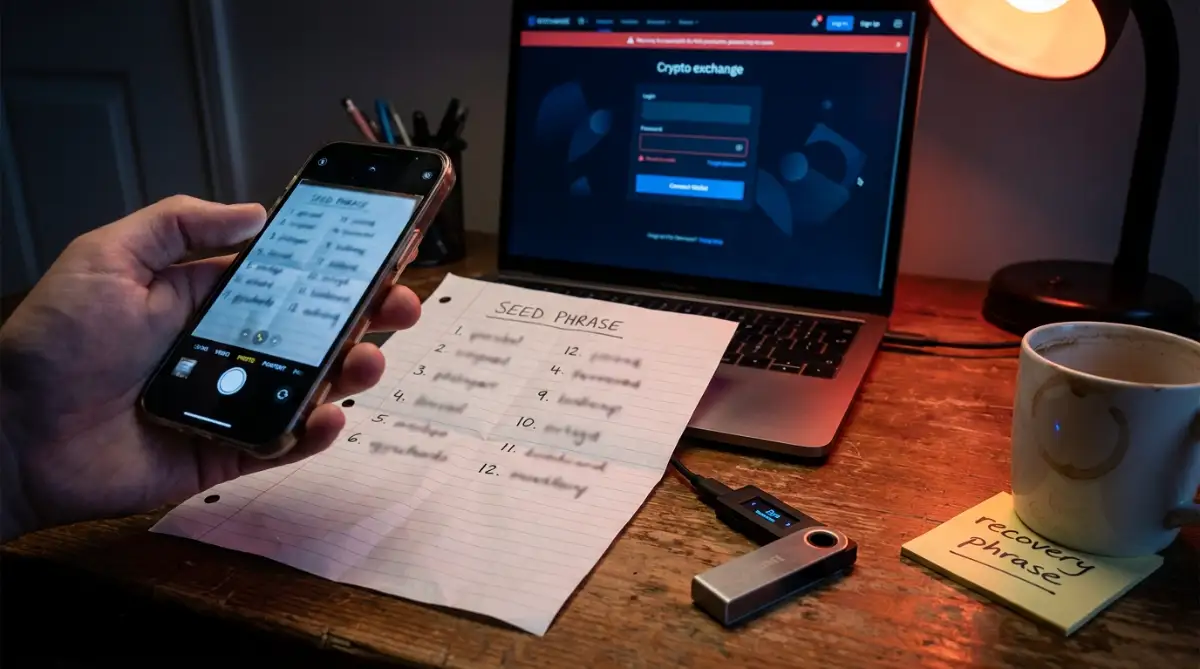
Mistake Seven: Falling for Fake Recovery Websites
Phishing websites are becoming increasingly convincing.
They often imitate trusted wallet interfaces and ask users to "verify" or "restore" their wallet.
The moment someone enters their recovery phrase, attackers immediately gain control.
Before entering recovery information anywhere, always verify:
- Website spelling
- Official domain
- Secure connection
- Trusted source
Being cautious for a few extra seconds can prevent permanent financial loss.
Mistake Eight: Keeping Only One Backup
Many users create only one handwritten copy.
If that copy is damaged by:
- Fire
- Water
- Theft
- Accidental disposal
- Fading ink
the recovery phrase could disappear forever.
Having multiple secure backups stored in separate safe locations greatly reduces this risk while maintaining security.
Mistake Nine: Storing the Backup in an Obvious Place
Some people hide recovery phrases in locations that are easy to guess.
Examples include:
- Wallets
- Desk drawers
- Laptop bags
- Under keyboards
- Phone cases
These places are often checked first during theft.
A backup should be stored somewhere secure, private, and difficult for unauthorized individuals to access.
Mistake Ten: Ignoring Physical Damage
Paper is surprisingly fragile.
Over time it can suffer from:
- Water damage
- Fire
- Humidity
- Mold
- Ink fading
- Tearing
Long-term cryptocurrency holders should periodically inspect physical backups to ensure they remain readable.
A backup that cannot be read is no backup at all.
Why Small Errors Become Permanent Problems
Unlike traditional financial institutions, cryptocurrency networks usually operate without centralized recovery systems.
This means there is often no organization capable of restoring access after a recovery phrase is permanently lost.
Because blockchain transactions are generally irreversible, prevention is always more effective than attempting recovery after a mistake.
This is why experienced investors spend significant time developing secure backup habits instead of focusing only on buying digital assets.
Building Better Security Habits from Day One
Wallet security should become part of your regular cryptocurrency routine.
Good habits include:
- Carefully reading wallet instructions during setup.
- Verifying every recovery word before storing it.
- Keeping backups private.
- Staying alert for phishing attempts.
- Reviewing backup quality occasionally.
- Avoiding unnecessary digital copies.
Strong security is built through consistent habits rather than one-time actions.
The Bigger Picture of Self-Custody
Self-custody offers independence and full ownership of digital assets, but it also removes the safety net provided by traditional financial institutions.
Every wallet owner becomes responsible for protecting access to their own cryptocurrency.
Understanding recovery phrase security is not just a technical skill—it is a fundamental part of responsible digital asset ownership.
The more carefully you protect your recovery phrase, the stronger your overall cryptocurrency security becomes.
Protecting Your Digital Assets for the Long Term
Every cryptocurrency investor hopes their portfolio grows over time, but long-term success depends on more than market performance. Secure ownership begins with protecting the recovery phrase that controls access to your wallet.
Most recovery phrase losses happen because of simple human mistakes rather than advanced cyberattacks. By avoiding risky storage methods, keeping accurate offline backups, and refusing to share your recovery phrase under any circumstances, you significantly reduce the chances of irreversible loss.
Treat your recovery phrase as the master key to your financial future. Developing careful security habits today can help ensure that your cryptocurrency remains accessible only to you, no matter how the digital landscape evolves.
Creating a Personal Recovery Phrase Protection Strategy
Understanding the risks is only the first step. The next step is creating a protection strategy that fits your situation and helps reduce the chance of accidental loss or unauthorized access.
A well-planned security routine does not need to be complicated. Instead, it should focus on consistency, privacy, and careful organization.
Ask yourself these questions:
- If my primary device stopped working today, could I still access my wallet?
- If my home experienced unexpected damage, would my backup survive?
- Does anyone else know where my recovery phrase is stored?
- Could someone accidentally discover it while looking through my belongings?
- Have I checked that every backup copy is still readable?
Regularly reviewing these questions can help identify weaknesses before they become serious problems.
How to Verify Your Backup Without Exposing It
Many wallet owners create a backup once and never think about it again. However, mistakes made during setup often remain unnoticed until recovery becomes necessary.
A safer approach is to carefully verify your backup shortly after creating it.
Depending on your wallet's features, you may be asked to confirm certain words or re-enter the phrase during setup. This helps ensure every word has been copied accurately.
If you choose to perform a recovery test, do so only in a trusted and secure environment using legitimate wallet software from official sources.
Avoid entering your recovery phrase into random websites or unknown applications simply to "check" whether it works.
Keeping Your Recovery Phrase Safe During Travel
Travel introduces additional security risks.
Carrying your only recovery phrase while traveling increases the possibility of loss, theft, or accidental damage.
If you must travel with cryptocurrency, consider these precautions:
- Avoid discussing your crypto holdings publicly.
- Keep your recovery phrase separate from the device containing your wallet.
- Never leave wallet information unattended in hotel rooms or vehicles.
- Be cautious when connecting to public computers or unfamiliar networks.
- Maintain awareness of your surroundings when accessing financial information.
Simple precautions can greatly reduce unnecessary exposure.
Protecting Yourself From Social Engineering
Not every attack involves malware or sophisticated hacking tools.
Many cryptocurrency thefts begin with conversation.
Criminals often spend days or weeks building trust before asking for sensitive information.
They may claim:
- Your wallet requires verification.
- Your account is at risk.
- You have won cryptocurrency rewards.
- A transaction failed.
- Your wallet needs immediate recovery.
These messages frequently create urgency because rushed decisions lead to mistakes.
Whenever someone pressures you to reveal private wallet information, pause and verify independently through official communication channels.
Why Privacy Matters Even Offline
Many investors focus on protecting their recovery phrase digitally but overlook physical privacy.
Avoid revealing details such as:
- Where your recovery phrase is stored.
- How many backup copies exist.
- Which wallet you use.
- The approximate value of your cryptocurrency.
The fewer people who know about your security arrangements, the smaller your exposure to targeted theft or manipulation.
Privacy remains one of the strongest forms of protection.
Organizing Multiple Wallets Responsibly
As cryptocurrency portfolios grow, some users create multiple wallets for different purposes.
For example:
- Long-term investments
- Everyday transactions
- Testing new blockchain applications
- Separate family funds
While this improves organization, it also increases the number of recovery phrases requiring protection.
Develop a clear labeling system that allows you to identify each wallet without exposing sensitive information.
Organization reduces confusion during recovery while helping prevent accidental mistakes.
Recognizing Emotional Decisions That Lead to Security Errors
People often make their biggest security mistakes during stressful situations.
Examples include:
- Market volatility
- Fear of losing funds
- Device failure
- Forgotten passwords
- Urgent scam messages
- Unexpected technical issues
Stress encourages rushed decisions.
Whenever you feel pressured, slow down before entering recovery information anywhere.
Most legitimate wallet processes allow enough time to verify every step carefully.
Security Habits That Experienced Crypto Holders Often Follow
Although every investor develops their own routine, many experienced cryptocurrency users share similar habits.
These include:
- Reading every wallet prompt carefully.
- Keeping recovery phrases completely offline whenever possible.
- Reviewing storage conditions periodically.
- Staying informed about new phishing techniques.
- Updating wallet software only from trusted official sources.
- Avoiding unnecessary sharing of cryptocurrency holdings.
Consistency is often more valuable than complicated security methods.
Warning Signs That Your Recovery Phrase May Be at Risk
Certain situations deserve immediate attention.
Consider reviewing your security if:
- Someone unexpectedly viewed your recovery phrase.
- You uploaded it to cloud storage by mistake.
- You entered it into an unfamiliar website.
- Your device became infected with malware.
- Your notebook containing the phrase disappeared.
- A backup became damaged or unreadable.
Recognizing these warning signs early gives you the opportunity to improve your overall security practices before additional problems develop.
Understanding the Difference Between Wallet Recovery and Password Recovery
These two concepts are frequently confused by beginners.
A forgotten wallet password may only affect access to a specific device.
A lost recovery phrase affects ownership of the wallet itself.
This distinction explains why wallet providers emphasize protecting recovery phrases from the very beginning.
The recovery phrase remains the ultimate method of restoring access across compatible devices.

Practical Habits for Everyday Crypto Safety
Recovery phrase protection should become part of your broader cryptocurrency security routine.
Helpful daily practices include:
- Locking devices with strong authentication.
- Keeping operating systems updated.
- Downloading wallet software only from official publishers.
- Double-checking wallet addresses before sending cryptocurrency.
- Avoiding suspicious links received through email or social media.
- Remaining cautious when interacting with unknown blockchain applications.
Security works best when every protective habit supports the others.
Frequently Asked Questions
Can I change my recovery phrase?
In most cases, a recovery phrase cannot simply be changed. If you believe it has been exposed, the typical approach is to create a new wallet with a new recovery phrase and securely transfer your assets when appropriate.
Is it safe to store a recovery phrase digitally?
Digital storage generally introduces additional risks such as malware, phishing, cloud synchronization, or unauthorized access. Many security professionals recommend maintaining secure offline backups whenever practical.
Should family members know my recovery phrase?
This depends on your personal planning and circumstances. Some people create inheritance or emergency access plans, but sharing a recovery phrase should always be carefully considered because anyone with access may also gain control of the wallet.
What happens if I lose both my device and recovery phrase?
For many self-custody wallets, permanently losing both means you may no longer be able to access the cryptocurrency stored in that wallet. This highlights why reliable backups are so important.
How often should I check my backup?
Periodically inspect your backup to ensure it remains complete, readable, and securely stored. The goal is to confirm it is still usable without unnecessarily exposing it to others.
Building Long-Term Confidence Through Better Security
Cryptocurrency ownership is not only about investing—it is also about responsible asset protection. The strongest portfolios are supported by careful security habits that remain consistent over time.
Whether you are holding a small amount of cryptocurrency or managing a larger portfolio, following secure backup practices, protecting your privacy, and remaining alert to scams can dramatically reduce unnecessary risks.
Developing these habits early allows you to focus more confidently on learning about blockchain technology and digital assets, knowing that the keys to your wallet are protected with the attention they deserve.
Disclaimer
This article is provided for educational and informational purposes only. It does not constitute financial, investment, legal, cybersecurity, or tax advice. Cryptocurrency involves risk, including the potential loss of digital assets. Always verify wallet instructions through official documentation, protect your recovery phrase carefully, and make decisions based on your own research and circumstances.