How Cryptocurrency Transfers Work: What Happens When You Send Crypto?
Sending cryptocurrency can feel surprisingly simple.
You open your wallet, enter an address, choose an amount, and press Send.
Within seconds, you may see a confirmation message on your screen. But behind that simple action, several technical processes are taking place across a global network of computers.
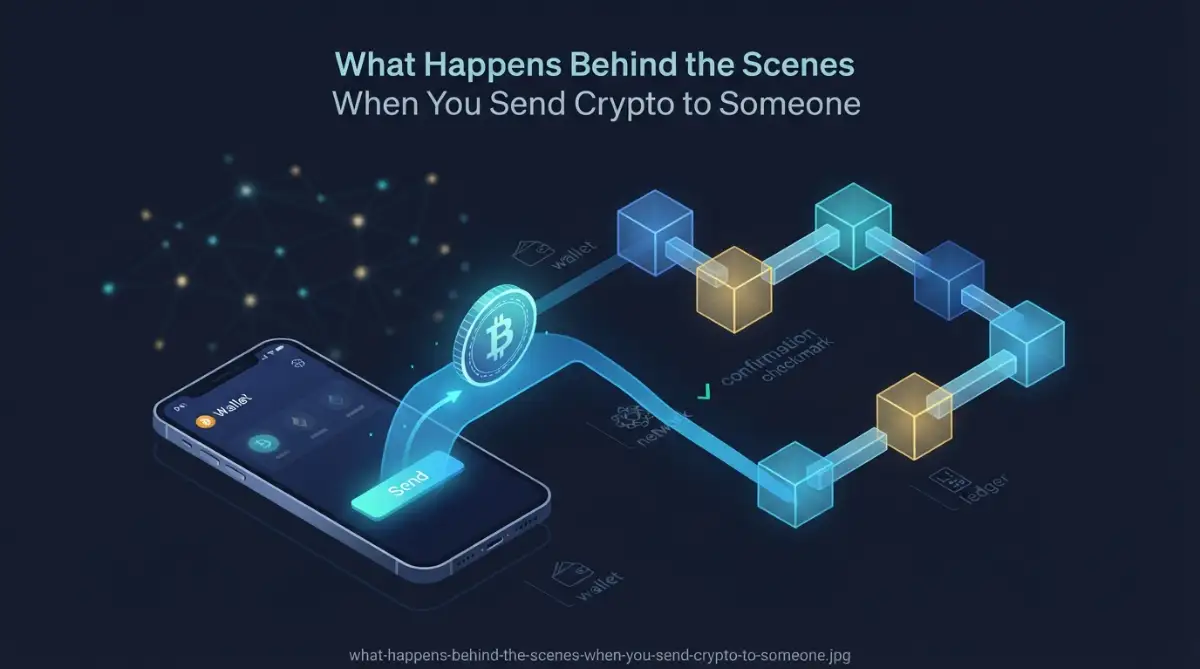
Unlike traditional bank transfers, cryptocurrency transactions do not usually depend on a central bank or a single company approving every payment. Instead, the transaction must be created, digitally signed, broadcast to a blockchain network, checked by independent computers, and eventually recorded in a block.
If you have ever wondered how cryptocurrency transfers work or where your crypto actually goes after pressing the Send button, this guide will explain the process in plain English.
Understanding this process can also help you avoid common mistakes, recognize suspicious transactions, and become more confident when using digital wallets.
According to Bitcoin.org's explanation of how Bitcoin works, cryptocurrency transactions rely on digital signatures and a shared public ledger known as the blockchain.
For Ethereum users, the official Ethereum transaction documentation explains that transactions are cryptographically signed instructions that update the network's state.
The important thing to remember is this:
Your cryptocurrency does not physically travel from one wallet to another like money moving between two bank accounts.
Instead, the blockchain updates its record to show that ownership or control of a certain amount of digital assets has changed.
Let's break down exactly what happens during a crypto transaction.
Why Understanding Crypto Transfers Matters
Imagine sending a small amount of cryptocurrency to a friend.
You expect the process to be straightforward. You copy their wallet address, enter the amount, pay a fee, and wait.
But what happens when the transaction remains pending for hours?
What if you accidentally choose the wrong network?
Or what if your friend says they have not received the funds even though your wallet says the transaction was successful?
These situations can create unnecessary stress, especially for beginners.
Many people assume that a crypto transfer works exactly like sending money through a banking app. That assumption often leads to confusion because blockchain transactions follow different rules.
Common Reasons People Get Confused
- Wallet balances may update before a transaction is fully confirmed.
- Different cryptocurrencies use different blockchain networks.
- A transaction fee does not always guarantee instant processing.
- Sending crypto to the wrong address can be difficult or impossible to reverse.
- Some transfers involve smart contracts instead of simple wallet-to-wallet payments.
The problem becomes worse when people rely on random social media advice or misleading videos.
One person may claim that every crypto transaction is instant. Another may say that six confirmations are always required. Someone else may recommend sending additional funds to "unlock" a pending transfer.
These statements are not universally true.
Understanding how cryptocurrency transfers work is safer than trusting assumptions.
The Hidden Stress Behind a Simple Crypto Transfer
A delayed cryptocurrency transaction can affect more than just your wallet balance.
For someone sending money to a family member, paying for a service, or transferring savings between wallets, uncertainty can quickly become stressful.
You may repeatedly refresh your wallet app.
You may check the blockchain explorer every few minutes.
You may wonder whether the funds are lost, whether the recipient entered the wrong address, or whether the network is experiencing a problem.
These concerns are understandable.
Why People Often Struggle to Find Clear Answers
- Technical blockchain terms can be difficult for beginners.
- Many online explanations focus on trading instead of basic transaction education.
- Different blockchains process transactions differently.
- Some websites simplify the process so much that important details are left out.
- Scam accounts often exploit people's fear when a transfer becomes delayed.
When people do not understand how transactions work, they can become vulnerable to poor decisions.
For example, a scammer may contact someone and claim that their crypto is "stuck" and requires an additional payment.
A person who understands that blockchain transactions do not normally require random payments to strangers for recovery has a better chance of recognizing the warning sign.
Knowledge does not eliminate every risk, but it can reduce unnecessary mistakes.
What This Uncertainty Does to Your Confidence
Crypto transactions are supposed to give users greater control over their digital assets.
However, that control can feel uncomfortable when the technology is unfamiliar.
A traditional bank transfer usually provides customer support, cancellation policies, and centralized records. Blockchain transactions often place more responsibility on the user.
That responsibility can create anxiety.
Common Emotional Reactions
- Fear of losing money permanently.
- Confusion about pending and completed transactions.
- Lack of confidence when choosing wallet addresses.
- Stress caused by unfamiliar fees and network settings.
- Dependence on online strangers for technical advice.
These reactions are common among new cryptocurrency users.
The solution is not to memorize complicated programming concepts. You simply need a clear understanding of what happens at each stage.
Once the process becomes familiar, sending crypto becomes much easier to understand.
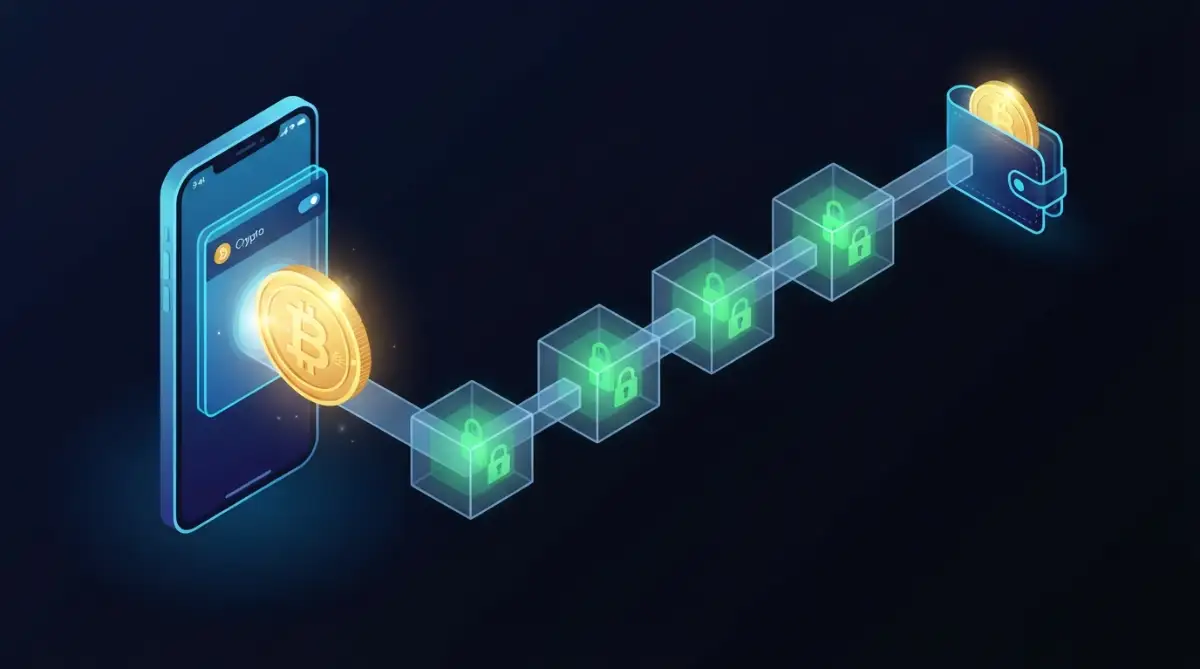
The Crypto Transfer Process: From Wallet to Blockchain
The best way to understand how cryptocurrency transfers work is to follow one transaction from beginning to end.
Imagine Alice wants to send cryptocurrency to Bob.
Alice has funds in her wallet. Bob provides his wallet address. Alice enters the amount and approves the transaction.
What happens next?
Several important stages begin immediately.
Step 1: Your Wallet Creates the Transaction
When you press the Send button, your wallet does not immediately move coins through the internet.
Instead, the wallet prepares a digital transaction.
This transaction contains information needed by the blockchain network.
Depending on the cryptocurrency, the information may include:
- The sender's wallet address.
- The recipient's wallet address.
- The amount being transferred.
- A transaction fee.
- Network-specific information.
- A digital signature proving authorization.
For example, on Ethereum, a transaction includes details such as the sender, recipient, value, signature, nonce, and gas-related information.
The wallet organizes these details into a format that the blockchain network can understand.
Why the Wallet Address Matters
A cryptocurrency wallet address works somewhat like an email address.
If you want to send an email, you need the correct recipient address.
Similarly, if you send cryptocurrency, you need the correct blockchain address.
However, crypto addresses are usually long strings of letters and numbers, making them difficult to verify manually.
This is one reason why sending a small test amount can sometimes be a useful precaution when transferring funds to a new address.
Always check the recipient address and network before confirming a transaction.
A single incorrect character or incompatible network can create serious problems.
Your Private Key Is Not Sent
One common misunderstanding is that your private key travels along with the transaction.
It does not.
Your wallet uses the private key to create a digital signature.
The private key itself should remain secret.
This signature acts as mathematical proof that the transaction was authorized by the owner of the wallet.
Bitcoin.org explains that private keys are used to sign transactions, while the blockchain records the resulting transfer of value.
You can read more about how blockchain technology works in simple English if you want a clearer introduction to the technology behind cryptocurrency.
Step 2: The Transaction Is Digitally Signed
Before a cryptocurrency transaction can be accepted by the network, it must be authorized.
This happens through cryptographic signing.
Think of a digital signature as a mathematical stamp that proves ownership.
Your wallet uses your private key to sign the transaction without revealing the private key itself.
Other computers on the blockchain network can verify the signature using the corresponding public information.
Why This Matters for Security
The digital signature helps answer an important question:
Did the actual owner authorize this transaction?
Without this verification system, anyone could potentially claim ownership of someone else's cryptocurrency.
The signature helps prevent unauthorized spending.
For Ethereum transactions, the official documentation describes the signature as proof that the sender authorized the transaction.
The same basic principle applies across many blockchain systems, although technical details vary between networks.
A Simple Analogy
Imagine signing a legal document with a unique signature.
The document contains the agreement, but the signature proves that you approved it.
In cryptocurrency, the digital signature serves a similar purpose, except it is created and verified through cryptographic mathematics.
The difference is that blockchain networks use software and mathematical rules rather than a bank employee or government office to verify authorization.
Step 3: The Transaction Is Broadcast to the Network
Once your wallet signs the transaction, it sends the transaction data to the cryptocurrency network.
This process is called broadcasting.
Your transaction is shared with blockchain computers known as nodes.
Nodes are computers that participate in maintaining and checking the blockchain.
They receive transaction requests and evaluate whether those transactions follow the network's rules.
For example, a node may check:
- Is the digital signature valid?
- Does the sender have enough funds?
- Is the transaction format correct?
- Is the transaction fee acceptable?
- Has the same cryptocurrency already been spent elsewhere?
If the transaction passes the required checks, it may enter a waiting area known as the mempool or transaction pool.
What Is a Mempool?
The mempool is a collection of pending transactions waiting to be included in a blockchain block.
You can think of it as a queue.
When many people are sending cryptocurrency at the same time, the queue can become crowded.
This is one reason why transaction fees and processing times may change.
A transaction with a higher fee may receive priority depending on the blockchain's rules and current network conditions.
However, paying a higher fee does not guarantee that every transaction will be processed immediately.
Different blockchains use different systems for selecting and confirming transactions.
Why Your Crypto Transfer May Show as Pending
Seeing the word "Pending" on your wallet screen does not necessarily mean something has gone wrong.
It usually means the transaction has been submitted but has not yet reached the required stage of confirmation.
This distinction is important.
Pending Does Not Always Mean Lost
A pending transaction may be waiting because:
- The blockchain network is busy.
- The transaction fee is lower than current network demand.
- Validators or miners have not yet included it in a block.
- The wallet application has not refreshed its status.
- The transaction requires additional network confirmations.
Bitcoin transactions, for example, are broadcast across the network before miners include them in blocks.
Bitcoin.org explains that receiving a payment notification can happen quickly, while confirmation requires inclusion in the blockchain.
You can also explore how blockchain confirmations work to understand why waiting for confirmations matters.
The Role of Crypto Transaction Fees
Every blockchain transaction requires resources from the network.
Computers must process, verify, and record the transaction.
Transaction fees help compensate the participants responsible for maintaining the network.
However, the way fees work depends on the blockchain.
Bitcoin Transaction Fees
Bitcoin uses a fee market where users attach transaction fees to encourage miners to include their transactions in blocks.
When network demand increases, users may compete for limited block space.
This can result in higher fees or longer waiting times.
Ethereum Gas Fees
Ethereum uses gas to measure the computational work required to process transactions.
Simple transfers require less computational work than complex smart contract interactions.
The Ethereum documentation explains that transactions require fees and must be included in a validated block.
Why Fees Sometimes Surprise Beginners
Many new users assume that sending $10 worth of cryptocurrency should always cost a small amount.
But blockchain fees are not always directly proportional to the amount being sent.
Sending a small amount during a busy network period may still involve a relatively high transaction fee.
This is why understanding the network you are using matters before confirming a transfer.
What Happens When Validators or Miners Process Your Transaction?
Once your transaction enters the network, it must be included in a block.
A block is a collection of transactions grouped together.
The blockchain network uses a consensus mechanism to determine which transactions are valid and how they become part of the permanent record.
Different networks use different consensus systems.
Bitcoin Uses Mining-Based Consensus
Bitcoin relies on miners to process transactions and add new blocks.
Miners compete to solve cryptographic problems according to the network's rules.
When a valid block is accepted, the transactions inside it receive confirmation.
Ethereum Uses Proof-of-Stake
Ethereum uses a proof-of-stake system.
Validators participate in securing the network and proposing or checking blocks.
According to Ethereum's official documentation, validators execute transactions, verify proposed blocks, and help maintain agreement about the network's state.
The technical details differ, but the basic goal is similar:
Independent participants must agree that the transaction is valid before it becomes part of the blockchain record.
Why Blockchain Confirmations Matter
A transaction may appear successful in your wallet before it has received a confirmation.
This can sometimes confuse users.
A confirmation means the transaction has been included in a validated blockchain block.
As more blocks are added after that block, confidence in the transaction's permanence generally increases.
Bitcoin Confirmations Explained Simply
Bitcoin.org explains that each additional confirmation makes reversing a transaction more difficult.
This is because changing an older transaction would require overcoming the network's consensus and cryptographic protections.
However, confirmation requirements can vary depending on the amount involved, the recipient's policies, and the specific cryptocurrency.
There is no universal rule that every crypto transfer requires exactly the same number of confirmations.
A Practical Example
Imagine sending Bitcoin to a friend.
Your wallet may show:
- Transaction submitted.
- 0 confirmations.
- 1 confirmation.
- Several confirmations.
At zero confirmations, the transaction has been broadcast but has not yet been included in a block.
After inclusion in a block, it receives its first confirmation.
As more blocks follow, the transaction becomes increasingly established in the blockchain history.
This is why some exchanges and businesses wait for multiple confirmations before considering a deposit fully settled.
A Simple View of How Cryptocurrency Transfers Work
Here is the complete journey in plain English:
The process may take seconds, minutes, or longer depending on the blockchain and network conditions.
Important Safety Lessons Before Sending Crypto
Understanding how cryptocurrency transfers work is helpful, but safe habits matter just as much.
Before sending cryptocurrency, always take a moment to review the transaction details.
Check These Things Every Time
- Confirm the recipient's wallet address.
- Verify that both wallets support the same blockchain network.
- Review the amount before approving.
- Check the transaction fee.
- Avoid sharing your private key or recovery phrase.
- Be cautious of anyone asking for extra money to release or recover funds.
Never Trust Urgency Alone
Scammers often create urgency.
They may claim your wallet will be frozen or your transaction will disappear unless you act immediately.
Legitimate blockchain transactions follow network rules.
They do not normally require random individuals to send additional cryptocurrency to unlock funds.
When something feels confusing or urgent, pause and verify the information through official documentation or trusted support channels.
When Your Crypto Transaction Enters the Blockchain
The first part explained how a transaction is created, signed, broadcast, and confirmed. Now we can look at what happens after those initial stages, especially when something does not go as expected.
Many crypto users become confused at this point because wallet applications often show simplified information, and different blockchain networks use different transaction models and terminology.
A transaction may appear successful while the recipient is still waiting. Another transfer may show as pending even though the network has already processed it. On some networks, a transaction can be accepted into a block but still be considered reversible or subject to reorganization until additional confirmations occur.
Understanding these differences can save you from unnecessary panic.
Step 4: Finding Your Transaction on the Blockchain
Every cryptocurrency transaction generates a unique identification code.
This code is commonly called a transaction ID, transaction hash, or TXID. Some networks and wallet interfaces may use different labels, and certain account-based systems may also display related identifiers for contract calls or internal transfers.
Think of it as a tracking number for your digital payment.
When you send crypto, your wallet usually provides this transaction hash after broadcasting the transaction. However, some wallets may show a local reference first, delay displaying the hash, or provide limited details until the transaction is accepted by the network.
What Information Does a Transaction Hash Show?
A blockchain explorer can use the transaction hash to display details such as:
- The sending address or account.
- The receiving address, account, or contract.
- The amount transferred.
- The transaction fee or network cost.
- The transaction status.
- The block number, slot, or other network-specific inclusion reference.
- The number of confirmations or subsequent blocks.
- For smart-contract transactions, execution results and event details.
The exact information varies by blockchain. Some networks use account balances and nonces, while others use unspent transaction outputs. Some explorers also distinguish between a transaction being included in a block and the resulting transfer or contract execution being successful.
This information is publicly visible on most public blockchains.
However, public visibility does not automatically reveal the real-world identity of the wallet owner.
The blockchain records addresses and transactions, while identifying the person behind an address may require additional information from exchanges or other sources.
Why Blockchain Explorers Are Useful
Suppose your friend says they have not received your crypto.
Instead of immediately assuming the funds are lost, you can check the transaction hash using the appropriate blockchain explorer. Use an explorer that supports the specific network and asset, because a hash may not be recognized across unrelated blockchains.
The explorer may show one of several statuses:
Pending, unconfirmed, or in the mempool: The transaction has been broadcast but has not yet been included in a block or finalized according to that network's rules. Some networks do not maintain a single shared mempool, so a transaction may be visible to some nodes or wallet services but not others.
Confirmed or included: The transaction has been included in a block or ledger update. The meaning of "confirmed" varies: on some networks it means one block inclusion, while on others wallets may wait for several confirmations or a separate finality threshold.
Finalized or irreversible under normal network rules: The transaction has reached the network's accepted finality standard. This is stronger than merely appearing in a block, although exceptional reorganizations, consensus failures, or service-specific policies can affect how finality is treated.
Failed or reverted: The network processed the transaction but the intended operation did not complete, often because of a smart-contract error, invalid conditions, or insufficient execution resources. On some networks, the transaction fee may still be charged even though the state change failed.
Dropped, expired, or replaced: The transaction is no longer being considered by the relevant nodes, may have expired under network rules, or was superseded by another transaction. A wallet may continue displaying an old transaction even after the network has stopped relaying it.
This information helps separate a technical delay from an actual mistake.
A Real-Life Scenario: The Transfer Looks Successful, But the Recipient Cannot See It
Imagine you send cryptocurrency to a friend.
Your wallet displays "Sent Successfully."
Your friend opens their wallet and sees nothing.
At first, this can feel alarming.
But several explanations are possible.
The Recipient's Wallet May Need to Refresh
Some wallets do not immediately update balances.
The transaction may already exist on the blockchain, but the wallet application has not synchronized with the network, indexed the relevant token, or refreshed its local data.
Closing and reopening the application or checking the blockchain explorer can sometimes clarify the situation. The explorer may show that the transfer was completed even if the wallet interface has not yet displayed the asset.
The Recipient May Be Checking the Wrong Network
This is a common issue.
For example, some assets can exist on multiple blockchain networks.
A token sent through one network may not automatically appear in a wallet interface configured for another network. The funds may not necessarily be gone, but accessing them can require selecting the correct network, adding the token manually, or using a compatible wallet. Recovery may be difficult or impossible if the receiving service does not support that network.
Always confirm the network before sending digital assets.
This is one of the simplest habits that prevents expensive mistakes.
The Wallet May Be Showing a Different Transaction State
Wallet interfaces do not all use the same labels. "Sent," "submitted," or "completed" may mean that the wallet broadcast the transaction, not that the recipient's balance has been updated or that the transaction has reached finality.
Check the transaction hash on the relevant explorer and compare the network's status with the wallet's wording before sending another payment.
Step 5: Understanding Failed Crypto Transactions
Not every blockchain transaction reaches completion.
Sometimes a transaction fails.
This does not always mean the entire wallet balance has disappeared.
The exact result depends on the blockchain, the transaction model, and the type of transaction.
Why Can a Crypto Transaction Fail?
Several technical reasons may cause failure.
Insufficient Funds
A wallet needs enough balance to cover both the amount being sent and any required network fee.
For example, if you have exactly enough cryptocurrency for the payment but not enough to cover the transaction fee, the transfer may not be accepted.
Some networks also require a separate native asset to pay fees for token transfers or smart-contract interactions. A wallet may show a token balance while lacking the network's fee currency.
Incorrect Network Conditions
Some blockchain networks require specific transaction settings.
A wallet may reject a transaction if the network is congested or if the transaction parameters are invalid. Transactions can also remain pending when their fee, priority, gas limit, or expiration settings do not meet current network conditions.
On networks that support replacement, a pending transaction may be superseded by another transaction from the same account. On other networks, replacement may not be available or may follow different rules.
Smart Contract Errors
Token transfers involving smart contracts can fail for reasons that do not apply to simple cryptocurrency transfers.
A smart contract may reject an action because certain conditions were not met.
This is different from sending a native coin directly from one wallet address to another. A transaction can also be included in a block while the contract execution fails, meaning the transaction itself is recorded but the intended state change does not occur.
Technical Wallet Problems
Sometimes the issue is with the wallet application rather than the blockchain itself.
A temporary synchronization issue, outdated software, incorrect network configuration, or an explorer indexing delay may affect what you see on the screen.
When a transaction fails, checking the blockchain record is usually more useful than repeatedly pressing the Send button.
The Difference Between a Failed Transaction and a Lost Transaction
These two terms are often confused.
A failed transaction means the blockchain did not complete the intended action, although the transaction may still be permanently recorded and may still consume a fee.
A lost transaction usually refers to a situation where funds cannot be accessed or recovered because of an incorrect address, unsupported network, lost private keys, or another serious issue.
These are not the same thing.
Failed Transactions
Depending on the network, a failed transaction may still consume a network fee because computers used resources to process the request.
The original funds may remain in the sender's wallet, but this should be verified on the relevant blockchain rather than assumed from the wallet interface.
On some networks, a transaction that is rejected before inclusion may not consume a fee, while a transaction that is included but fails during execution may still incur one.
Wrong Address Transfers
Sending cryptocurrency to an incorrect address can be much more serious.
On many blockchain networks, transactions cannot simply be reversed by contacting customer support.
There is generally no central authority that can automatically cancel a completed blockchain transaction. Some custodial services may be able to help in limited circumstances, but recovery depends on the service, network, address type, and recipient's cooperation.
This is why wallet address verification deserves careful attention.
Advanced TipUsese the Blockchain Explorer Before Contacting Support
When something appears wrong, gather evidence first.
A transaction hash is often the most useful piece of information.
Before contacting a wallet provider, exchange, or technical support team, check:
- Whether the transaction exists on the correct blockchain.
- Whether it is pending, included, failed, dropped, expired, or replaced.
- Whether it has reached the number of confirmations or finality level required by the recipient service.
- Whether the receiving address is correct.
- Whether the transaction used the intended network.
- Whether the recipient wallet supports that asset and network.
- Whether the explorer is showing a transaction result, token transfer, or contract execution failure.
This approach makes troubleshooting more organized.
Instead of saying, "My crypto disappeared," you can provide a specific transaction ID and explain exactly what happened.
That can save time and reduce confusion.
Why Some Crypto Transactions Cannot Be Canceled
Traditional financial systems often include centralized controls.
A bank transfer may sometimes be recalled. A card payment may be disputed. A payment processor may freeze or reverse certain transactions.
Blockchain systems generally work differently.
Once a transaction is confirmed according to network rules, reversing it may not be possible. Before confirmation, some networks allow a transaction to be replaced, canceled through a protocol-specific mechanism, or dropped if it is not included before expiration. These options are not universal and may not be supported by every wallet.
What Makes Blockchain Transfers Different?
The blockchain is designed to maintain a shared record.
When transactions are accepted into that record, changing historical information would require overcoming the network's security and consensus mechanisms.
This does not mean every blockchain transaction is absolutely irreversible in every technical situation.
A transaction may be replaced while pending on some networks, or a block may be reorganized before the network considers it final. A custodial platform may also reverse an internal transfer under its own policies. However, users should treat confirmed transfers as final unless the specific blockchain or service clearly provides another mechanism.
A Useful Rule to Remember
Before pressing Send, assume the transaction cannot be undone.
This mindset encourages careful checking.
It is much safer to spend one extra minute reviewing an address than to spend weeks trying to recover funds sent incorrectly.
Protecting Yourself During Cryptocurrency Transfers
The technology behind blockchain is only part of the picture.
User behavior plays a major role in protecting digital assets.
Even a secure blockchain cannot protect someone who voluntarily gives away their private key or sends funds to a scammer.
Keep Your Recovery Phrase Private
Your recovery phrase is one of the most sensitive pieces of information associated with a self-custody wallet.
It can potentially restore access to the wallet and its assets.
You should never share it with:
- Online strangers.
- Fake customer support agents.
- Social media accounts claiming to be wallet representatives.
- Anyone promising guaranteed recovery of lost crypto.
A legitimate support representative should not need your private recovery phrase to verify a normal transaction.
Store Recovery Information Carefully
Many users keep sensitive wallet information in screenshots, cloud storage, or messaging applications.
These methods may expose the information to unauthorized access.
For long-term storage, users often consider offline methods and secure physical storage.
You can also read this guide on setting up a secure cold wallet to understand the principles behind keeping private keys away from internet-connected devices.
The Importance of Small Test Transactions
When sending cryptocurrency to a new wallet address, a small test transfer can sometimes reduce the risk of a major mistake.
This approach is especially useful when:
- Sending funds to a new recipient.
- Using a new wallet application.
- Moving assets between platforms.
- Working with unfamiliar blockchain networks.
The idea is simple.
Instead of sending the entire amount immediately, you first confirm that the destination address and network are correct.
Once the test transaction is received successfully and has reached the recipient's required confirmation or finality threshold, you can decide whether to proceed with the remaining amount.
Important Limitation
A test transaction does not guarantee complete safety.
It confirms that one transfer reached the intended destination, but it does not protect against every type of scam or technical problem.
You should still verify the recipient, network, and wallet details independently.
How to Build Better Crypto Transfer Habits
Experienced cryptocurrency users often rely on routines rather than memory.
They do not assume they will remember every detail correctly.
Instead, they create simple habits that reduce mistakes.
A Practical Pre-Send Routine
Before approving a transaction, take a short pause.
Check the following:
Recipient Verification
Confirm the wallet address using a trusted source.
If someone sends you an address through an unfamiliar message or social media account, verify it through another communication method.
Network Verification
Make sure the sending and receiving platforms support the same blockchain network.
Do not assume that similar-looking addresses always belong to the same network. Address formats can overlap across networks, while the asset and transaction rules may differ.
Amount Verification
Check the amount twice.
Pay attention to decimal points, especially when dealing with large quantities of cryptocurrency.
Fee Verification
Review the network fee before confirming.
A transaction fee is separate from the amount being sent.
Some wallets display both values clearly, while others require opening an additional confirmation screen. On some networks, fees may vary with congestion, priority, gas usage, or transaction size.
Final Review
Read everything on the confirmation screen before approving.
This short pause can prevent a costly mistake.
Expert Insight: Why Crypto Education Matters More Than Speed
Many people focus heavily on transaction speed.
They want transfers to happen instantly.
But speed should not be the only measure of a good transaction experience.
A fast transfer to the wrong address is still a serious problem.
A slower transfer that is correctly verified may be much safer.
This is especially important for beginners who are still learning how different blockchain networks operate.
Focus on Understanding the Process
Instead of asking only, "How fast will my crypto arrive?"
Also ask:
- What network am I using?
- How are transactions confirmed or finalized on this network?
- What happens if the transaction fails?
- Can a pending transaction be replaced, dropped, or expired?
- Where can I verify the transaction status?
- What information should never be shared?
These questions help build practical confidence.
Common Mistakes That Create Serious Problems
Most cryptocurrency transaction mistakes happen before the blockchain even receives the transaction.
The problem is often human error.
A rushed decision, copied address, or misunderstood network can create consequences that are difficult to reverse.
Sending Crypto to the Wrong Address
This is one of the most serious mistakes a user can make.
Blockchain addresses are designed for accuracy, not convenience.
If funds are sent to an incorrect address controlled by someone else, recovery may depend entirely on whether the recipient voluntarily returns the funds.
There is no universal customer service department that can automatically retrieve them.
How to Reduce This Risk
Use copy-and-paste carefully.
Compare the first and last characters of the address.
When possible, use trusted address-book features or verified wallet contacts.
Never rely only on visual familiarity.
Choosing the Wrong Blockchain Network
A cryptocurrency may be available across several networks.
For example, a token might exist on different blockchain ecosystems.
If the receiving platform only supports one network but you send through another, the funds may not appear automatically.
Sometimes recovery is possible through technical steps or platform support.
Sometimes it is not.
Network compatibility should always be confirmed before sending.

Trusting Fake Customer Support
Scammers often target people who are experiencing transaction problems.
They may monitor public discussions or respond to social media posts about missing crypto.
Then they offer to "fix" the issue.
Their goal is often to obtain sensitive information or convince the victim to send additional funds.
Warning Signs of a Scam
- Requests for your recovery phrase.
- Promises of guaranteed fund recovery.
- Pressure to act immediately.
- Requests for an upfront crypto payment.
- Claims that your wallet must be "unlocked" through a private transfer.
Legitimate support processes should be verified through official channels.
Avoid trusting unsolicited direct messages.
Repeating a Transaction Without Checking Its Status
When a transaction appears stuck, some users immediately send another payment.
This can create additional confusion.
You might accidentally send the funds twice.
Before repeating a transfer, check the original transaction hash and blockchain status. Confirm whether the original transaction is pending, included, finalized, failed, dropped, expired, or replaced.
A few minutes of investigation can prevent duplicate payments.
A Simple Troubleshooting Guide for Crypto Transfers
This table is not a substitute for technical support, but it provides a practical starting point.
What Beginners Should Understand About Wallet Balances
Your wallet balance is not always a complete picture of what is happening on the blockchain.
A wallet application is an interface.
It reads blockchain data and presents it in a user-friendly format.
Different wallet applications may update at different speeds or display assets differently.
Why Balances Can Sometimes Look Wrong
- Network synchronization delays.
- Unsupported tokens.
- Incorrect network selection.
- Pending transactions.
- Cached wallet information.
- Temporary application errors.
- A transaction that was included but failed during contract execution.
- A wallet interface that has not indexed a token transfer or internal transaction.
If your balance looks unusual, do not immediately assume your funds are gone.
First verify the address and transaction history on the relevant blockchain explorer.
This is often the fastest way to separate a display issue from a real transaction problem.
A Long-Term Routine for Safer Crypto Use
Good cryptocurrency habits become easier when they are repeated consistently.
You do not need to become a blockchain developer.
You simply need a personal system.
Before Every Transfer
Review the address, network, amount, and fee.
After Every Transfer
Save the transaction hash when appropriate.
Check whether the transaction has been included, confirmed, or finalized according to the relevant network and recipient service.
For Important Transfers
Consider sending a small test amount first.
Use secure devices and avoid public computers.
For Long-Term Storage
Keep recovery information private and secure.
Consider learning about offline wallet security and self-custody practices.
When Something Goes Wrong
Stop.
Do not send additional funds to strangers.
Verify the blockchain record before taking further action.
Final Checklist: What to Remember Before Sending Crypto
Here is a simple checklist you can keep in mind:
Wallet and Address
- Is the recipient address correct?
- Did I verify the address through a trusted source?
- Does the destination wallet support this asset and network?
Network and Fees
- Am I using the correct blockchain network?
- Have I reviewed the transaction fee?
- Do I have enough balance for both the payment and fee?
- Does this network require a separate native asset to pay the fee?
Security
- Am I keeping my private key and recovery phrase private?
- Am I responding to a legitimate support channel?
- Is anyone pressuring me to act quickly?
After Sending
- Did I save or record the transaction hash?
- Can I verify the transaction on a blockchain explorer that supports this network?
- Is the transaction pending, included, failed, dropped, replaced, or finalized?
- Has the recipient confirmed receipt?
These small habits can make a significant difference in how confidently you manage cryptocurrency transfers.
Building Confidence One Transaction at a Time
Cryptocurrency can seem mysterious when you only see the final balance change on a wallet screen.
But once you understand the journey behind that balance, the process becomes much clearer.
A crypto transfer is not simply a button press.
It involves digital authorization, network communication, verification, consensus, and public recordkeeping.
The most useful knowledge is practical knowledge.
Know how to check a transaction hash.
Know the difference between pending, included, confirmed, finalized, failed, dropped, and replaced.
Know why network selection matters.
Know that a transaction included in a block may not have reached the same level of finality on every network.
Know that confirmed or finalized blockchain transactions should generally be treated as final, even though limited replacement, reorganization, or service-specific reversal mechanisms may exist before or outside that point.
Most importantly, never allow urgency or fear to replace careful verification.
You do not need to understand every technical detail of blockchain technology to use cryptocurrency responsibly.
Start with the basics, build good habits, and take a moment to check your information before every important transfer.
A few careful seconds before sending can protect you from problems that may otherwise take much longer to resolve.
Educational Disclaimer
This article is provided for general educational and informational purposes only. Cryptocurrency transactions involve technical, financial, and security risks. Always verify transaction details independently and consult official documentation or qualified professionals when dealing with significant digital assets. This article does not provide financial, investment, legal, or tax advice.