Myth-Busting: Is Crypto Really Anonymous? What You Need to Know
Cryptocurrency is often talked about as a private and anonymous way to send money online. That idea has attracted millions of people who care about financial privacy and want more control over their transactions.
But there’s an important detail many beginners miss:
Crypto is usually not fully anonymous.
In most cases, it’s better described as pseudonymous. Your real name might not show up next to a transaction on a public blockchain, but the transaction itself can still be seen, analyzed, and sometimes linked back to a real person or organization.
That difference really matters.
Whether you’re buying crypto, sending funds between wallets, receiving assets, or just learning how blockchain works, understanding how privacy actually works can help you make smarter security decisions.
So, how private is crypto really?
Let’s break it down in simple terms.
Why So Many People Think Crypto Is Anonymous
The idea of crypto anonymity didn’t come out of nowhere.
In traditional finance, transactions are usually tied to your identity. Banks and payment apps know who you are and can connect your activity to your personal details.
Crypto works a bit differently.
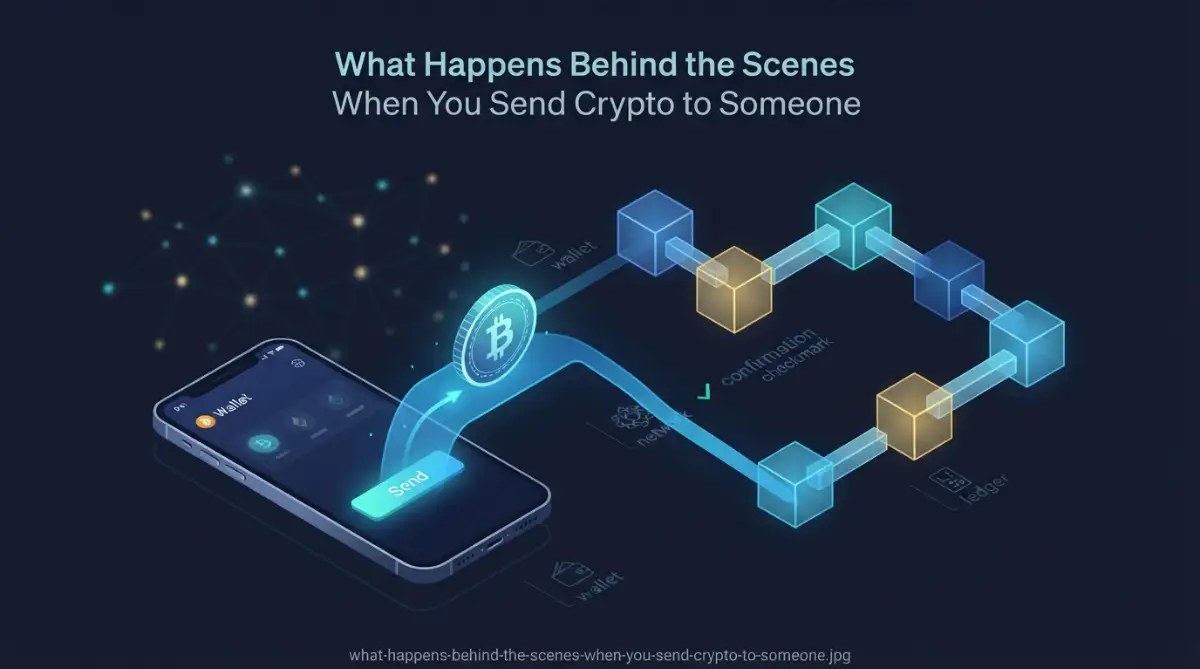
A typical blockchain transaction might show things like:
- A wallet address
- The receiving wallet address
- The amount sent
- The time of the transaction
- Transaction ID details
- Other public blockchain data
But it usually won’t show your name, address, or phone number right there on the blockchain.
So to someone new, it can feel completely anonymous.
But there’s a big difference between not showing your name publicly and being untraceable.
That’s where the confusion starts.
Anonymous vs. Pseudonymous: The Key Difference
To really understand crypto privacy, you need to know two simple ideas: anonymous and pseudonymous.
What “Anonymous” Means
True anonymity means it’s extremely hard (or impossible) to figure out who is behind an action using the available data.
There’s no clear link between the activity and a real person.
What “Pseudonymous” Means
Pseudonymous means you’re using an identifier instead of your real identity.
In crypto, that identifier is usually a wallet address.
So instead of seeing:
John Smith sent 0.5 crypto to Jane Doe
You might see:
Wallet A sent 0.5 crypto to Wallet B
No names involved.
But the transaction is still permanently recorded on the blockchain.
And if someone later figures out that Wallet A belongs to John Smith, then all past activity from that wallet could potentially be linked to him.
That’s why crypto is considered pseudonymous, not fully anonymous.
The Blockchain Is a Permanent Public Record
One of the biggest features of most cryptocurrencies is transparency.
A blockchain is basically a shared digital record that stores all transactions based on the network’s rules.
On public blockchains, anyone can use tools like blockchain explorers to view transaction data.
Depending on the network, you can often see:
- Wallet addresses
- Transaction amounts
- Timestamps
- Transaction history
- Wallet-to-wallet transfers
- Token movements
- Confirmation details
So here’s the interesting part:
Crypto can feel private because your name isn’t directly attached…
but at the same time, your activity can be very visible.
In short:
Your identity might be hidden, but your transaction history usually isn’t.
That’s a key thing to understand.
What a Wallet Address Actually Shows
A wallet address isn’t your name—but it’s not meaningless either.
It works like a public identifier for your blockchain activity.
For example, if a wallet keeps receiving funds and later sends them elsewhere, those movements can be tracked using public data.
The address itself won’t say:
“This belongs to Alex”
But patterns can still be analyzed.
And if that wallet ever connects to a known service or identity, things can become easier to link together.
How Crypto Platforms Can Link Identity to Wallets
A big misconception is that crypto automatically keeps you anonymous.
In reality, many people use centralized platforms like exchanges.
These platforms often require identity verification depending on regulations.
Here’s a simple example:
You buy crypto on an exchange using your real account. Then you withdraw it to a wallet.
On the blockchain, it just looks like a wallet address received funds.
But the exchange may still know:
your identity → your account → your withdrawal address
So even if the blockchain doesn’t show your name, other systems might connect the dots.
That’s why “anonymous” can be misleading.

Can Crypto Transactions Be Traced?
In many cases, yes—but not in a simple “click and reveal identity” way.
Tracing crypto usually means analyzing patterns and movement of funds.
Analysts may look at:
- Where funds came from
- Where they went next
- Timing of transactions
- Wallet connections
- Interaction with known services
- Address clusters and patterns
Because blockchain data is permanent, old transactions can still be studied years later.
So crypto doesn’t really “disappear” after sending—it stays recorded.
Why Blockchain Transparency Isn’t All Bad
At first, this level of visibility might sound like a privacy problem.
But transparency is also a big part of blockchain security.
Because transactions are publicly verifiable, users don’t have to fully trust a central authority.
Some benefits include:
Public Verification
Anyone can confirm transactions independently.
Clear Transaction History
You can track how funds move over time.
No Single Point of Control
Data is spread across a network instead of one company.
Better Auditability
Suspicious activity can sometimes be easier to investigate.
So privacy and transparency actually exist together in crypto.
Does a New Wallet Make You Anonymous?
Creating a new wallet can separate your activity—but it doesn’t guarantee anonymity.
If that wallet later connects to something linked to your identity, the connection can still be made.
For example:
New wallet → exchange account → verified identity
So while a fresh wallet starts off “clean,” it doesn’t stay anonymous forever if it gets linked.
The Role of Blockchain Analysis
Blockchain data can be studied in much deeper ways than just looking at one transaction.
Think of it like a giant network of connected dots.
Wallets send funds to other wallets, which interact with more wallets, and so on.
Over time, patterns start to appear.
Analysts use this to map relationships between addresses and transactions.
But this doesn’t mean everyone is identified—it just shows why blockchain activity isn’t completely private.
What About Privacy-Focused Cryptos?
Not all cryptocurrencies work the same way.
Some are designed to be more transparent, while others include stronger privacy features.
So saying “crypto is anonymous” is too general.
A better question is:
What does this specific blockchain actually reveal?
That gives you a much clearer picture.
Your Wallet Address Isn’t a Password
A public wallet address is meant to be shared so people can send you funds.
But it’s very different from sensitive information like:
- Private keys
- Seed phrases
- Passwords
- Security codes
Knowing your wallet address alone doesn’t give anyone access to your funds.
But it can still reveal your transaction activity over time.
The Biggest Myth: “No One Can See My Crypto Activity”
This is probably the most common misunderstanding.
Just because your name isn’t shown doesn’t mean your activity is invisible.
On public blockchains, anyone with your wallet address can view its transaction history.
They may not know who you are right away—but they can still see what the wallet is doing.
A better way to think about it is:
Crypto hides your name, not your activity.
What Crypto Users Should Keep in Mind
You don’t need to be a blockchain expert to protect your privacy.
Just be aware of what you’re sharing.
Before posting a wallet address publicly, think about whether you’re okay with people seeing its activity.
Also remember that blockchain privacy is only one part of your overall digital privacy.
Other things that matter include:
- Exchange accounts
- Device security
- Online activity
- Social media
- Transaction habits
A wallet address is just one piece of your digital footprint.
A Smarter Way to Think About Crypto Privacy
The truth is somewhere in the middle.
Crypto isn’t fully private, but it’s not completely exposed either.
It offers pseudonymity—not total anonymity.
Your name might not appear on the blockchain, but your activity can still be visible and analyzed.
Understanding that balance is key.
Key Takeaways
- A wallet address isn’t your real identity
- Most blockchains are publicly viewable
- Crypto transactions can often be traced
- Identity can be linked through outside information
- New wallets don’t guarantee anonymity
- Different cryptos offer different privacy levels
- Transparency also improves security
- Public addresses aren’t the same as private keys
The main idea is simple:
Crypto privacy is not the same as full anonymity.
Once you understand that, everything about blockchain security starts to make a lot more sense.
In the next part, we can look at how blockchain tracking actually works in real life, what kinds of mistakes expose user identity, and how transaction trails are followed step by step.
How Blockchain Transaction Trails Can Reveal More Than You Expect
In Part 1, we established an important distinction: cryptocurrency can be pseudonymous without being completely anonymous.
That distinction gets a lot more interesting when you look at what happens after a transaction is recorded.
A blockchain doesn’t just store isolated transfers. On many public networks, transactions form an interconnected history. One address interacts with another, funds move through different addresses, and those addresses may later interact with identifiable services.
This creates a trail.
The existence of that trail doesn’t mean anyone can instantly figure out who’s behind every wallet. But it does mean blockchain activity can sometimes reveal relationships users never meant to make public.
Understanding how those connections work is important for anyone using cryptocurrency.
How a Blockchain Transaction Trail Develops
Imagine a wallet that receives crypto from one address and later sends part of it to another address.
That second address then interacts with a few other wallets.
Each transaction adds another piece to the bigger picture.
A simplified chain might look like this:
Address A → Address B → Address C → Address D
The blockchain may not tell an observer who owns A, B, C, or D.
But it does preserve the relationships between them.
Now imagine Address D interacts with a service where the user’s identity is verified.
That interaction can potentially link previously pseudonymous blockchain activity to a real-world identity.
When a Wallet Becomes Connected to a Real Identity
A wallet address can exist without any obvious identity attached to it.
That changes when outside information connects the address to a person.
A few common ways this happens include:
Using an Identifiable Financial Service
When someone sends crypto to or from a service that keeps customer records, that service may be able to link accounts to specific transactions or addresses.
The blockchain won’t show a name, but the service’s internal data might.
Publicly Sharing an Address
Some people post wallet addresses on websites, social media, donation pages, forums, or other public places.
Once an address is publicly tied to a person or organization, it becomes much easier for others to connect activity on that address to the same identity.
Receiving Payments Directly
Businesses, creators, charities, and individuals often publish wallet addresses to receive payments.
That’s useful, but it also creates a visible link between an address and its recipient.
Reusing the Same Address
Using the same address over and over can make it easier to tie multiple transactions together.
So even if a user never shares their name, their activity can still become more traceable over time.
Why Address Reuse Can Reduce Privacy
One of the simplest privacy concepts is address reuse.
If someone uses the same address to receive payments from many people, every incoming transaction becomes part of that address’s visible history.
Over time, that builds a pretty detailed picture of activity.
Now compare that to using different addresses for different transactions.
The links between those transactions may be less obvious—but that still doesn’t guarantee anonymity.
Modern blockchain analysis looks at more than just matching addresses.
So the real takeaway isn’t:
“Never reuse an address and you’re anonymous.”
It’s more like:
How you manage addresses affects how easily your activity can be connected.
Transaction Patterns Can Reveal Relationships
Privacy on a blockchain isn’t just about single transactions.
Patterns matter too.
For example, a wallet that regularly receives funds and then forwards them in a consistent way can create recognizable behavior patterns.
Things like timing, amounts, destinations, and repeated structures can all be useful signals.
One transaction alone might not mean much.
But a long chain of them can start to tell a story.
This is similar to other types of data analysis: one data point is weak, but many connected ones can become much more revealing.
The difference with blockchains is that this data is public and long-lasting.
What Blockchain Explorers Can Show
A blockchain explorer is basically a tool that lets anyone view public blockchain data.
Depending on the network, it can show things like:
- Transaction status
- Block details
- Sending and receiving addresses
- Transfer amounts
- Timestamps
- Token movements
- Network fees
- Past activity linked to an address
This is useful for legitimate reasons.
For example, you can check whether a payment has gone through or is still pending.
Researchers also use this data to study network activity.
But the same transparency means users should remember: once a transaction is confirmed, it’s not exactly “hidden” anymore.
Blockchain Analysis Looks at Connections, Not Just Names
A common misconception is that blockchain analysis is like searching for someone’s name in a database.
It’s usually more indirect than that.
Analysts often start with an address and then look at how it connects to other addresses.
They may look for:
- Repeated interactions
- Shared transaction patterns
- Movement between related wallets
- Links to known services or entities
- Timing relationships
- Flow of funds
- Public information outside the blockchain
The goal is usually to understand relationships between addresses.
So a wallet isn’t really a standalone identity—it’s more like a point in a much bigger network.
Why Off-Chain Information Matters
One of the biggest ideas in crypto privacy is the difference between on-chain and off-chain data.
On-Chain Information
This is everything recorded directly on the blockchain, like:
- Transactions
- Addresses
- Amounts
- Network data
Off-Chain Information
This is everything outside the blockchain, such as:
- Account sign-up details
- Social media posts
- Website info
- Customer records
- Device or app logs
- Public or private databases
When these two types of information get combined, it becomes much easier to connect blockchain activity to real people.
That’s why looking only at the blockchain doesn’t give the full privacy picture.
The Social Media Problem Many Users Overlook
A lot of privacy issues don’t come from the blockchain itself—they come from what users post online.
For example, someone might say:
“Here’s my wallet address, send payments here.”
That one post can directly link a real identity to a blockchain address.
The blockchain didn’t reveal anything personal.
The user did.
So a big part of privacy is actually about what you choose to connect publicly.

Why Transaction History Deserves Attention
A single transaction doesn’t tell you much.
But a full wallet history can tell a lot more.
If an address has received funds from multiple sources, sent funds to different places, and interacted with various apps, patterns can start to emerge.
That’s why blockchain activity shouldn’t be thought of as “one-off events.”
On public networks, everything stays part of a long-term record.
That’s one of the core features of blockchain technology.
Common Privacy Mistakes Crypto Users Make
Even experienced users slip up sometimes. The most common mistakes are usually pretty simple:
Mistake 1: Assuming a Wallet Address Is Fully Anonymous
An address doesn’t show your name by default—but it can still become linked to you.
It’s better to think of it as pseudonymous, not anonymous.
Mistake 2: Posting Transaction Details Publicly
Screenshots, links, and payment info can reveal more than you expect when combined with blockchain data.
Mistake 3: Reusing Addresses Without Thinking About It
Reusing addresses can make it easier to connect your transactions over time.
Mistake 4: Treating Crypto Privacy Like General Internet Privacy
Protecting one part of your online identity doesn’t automatically protect your blockchain activity.
Mistake 5: Thinking Completed Transactions Disappear
They don’t. On public blockchains, they stay visible.
Mistake 6: Sharing Sensitive Wallet Credentials
Your public address is fine to share.
Your private key or recovery phrase is absolutely not.
If someone asks for it, that’s a major red flag.
Public Address vs. Private Credentials
This is a really important distinction.
A public wallet address is meant to receive funds.
A private key or recovery phrase gives full control over the wallet.
Think of it like this:
Public address = where money goes
Private key/recovery phrase = full access to the money
If someone asks for your recovery phrase for “verification” or “support,” you should be extremely cautious. There’s no legitimate reason to share it.
Privacy Does Not Mean Hiding From Legitimate Oversight
Crypto privacy isn’t about avoiding accountability.
It’s about controlling how much of your financial activity is exposed and to whom.
People may want privacy for many normal reasons—like avoiding unnecessary tracking or protecting personal information.
At the same time, financial systems still operate under laws and regulations.
So the goal isn’t to “disappear.”
It’s to understand what’s public, what’s private, and what can be connected.
How to Think More Carefully About Crypto Privacy
Before using or sharing a wallet address, it helps to ask a few simple questions:
What Can Someone See?
Check what the blockchain actually reveals.
What Could Be Connected?
Think about whether the address is tied to anything public.
What Am I Sharing?
Screenshots, links, and comments can add extra context.
How Long Will This Stay Visible?
Blockchain data doesn’t really expire.
Am I Protecting My Actual Credentials?
Never trade security for privacy mistakes.
A Practical Privacy Checklist for Everyday Users
You don’t need advanced tools to improve your privacy habits:
- Understand how transparent your blockchain is
- Treat addresses as pseudonymous, not anonymous
- Avoid posting transaction details unnecessarily
- Be careful linking addresses to your real identity
- Be aware of address reuse
- Keep private keys and recovery phrases secret
- Be cautious with screenshots and public posts
- Remember off-chain data matters too
- Don’t assume transactions become invisible
- Only use privacy tools when you understand them
The Real Meaning of “Anonymous Crypto”
So, is crypto anonymous?
Not really in most cases.
A better description is pseudonymous and transparent.
You don’t need to attach your name to every transaction—but your activity can still be visible, and sometimes linkable to you through other information.
That doesn’t make crypto useless for privacy.
It just means expectations should be realistic.
What This Means for Everyday Crypto Security
Crypto privacy isn’t a simple on/off switch.
It depends on blockchain design, wallet behavior, address reuse, public activity, and off-chain data.
So the safest mindset is just being aware.
Don’t assume everything is public.
But also don’t assume everything is hidden.
That balance is key to using crypto responsibly.
A Clear Takeaway for Crypto Users
The main idea is simple:
A blockchain address can hide your name, but not necessarily your activity.
Transactions can stay visible. Addresses can be linked. Public posts can connect identities. And outside data can fill in the gaps.
So instead of asking only “Is crypto anonymous?”, a better question is:
“What does my activity reveal, and what could it be connected to?”
That’s a much more realistic way to think about privacy in crypto.
Next up, it’s worth looking at crypto privacy tools, mixing services, and privacy-focused technologies—and what they actually do (and don’t do) for anonymity.
Disclaimer
This article is provided for general educational and informational purposes only. It is not financial, investment, legal, tax, cybersecurity, or privacy advice. Cryptocurrency and blockchain technologies involve risks, and privacy characteristics vary between networks, wallets, applications, and jurisdictions. Readers should independently verify information and consider qualified professional guidance where appropriate.